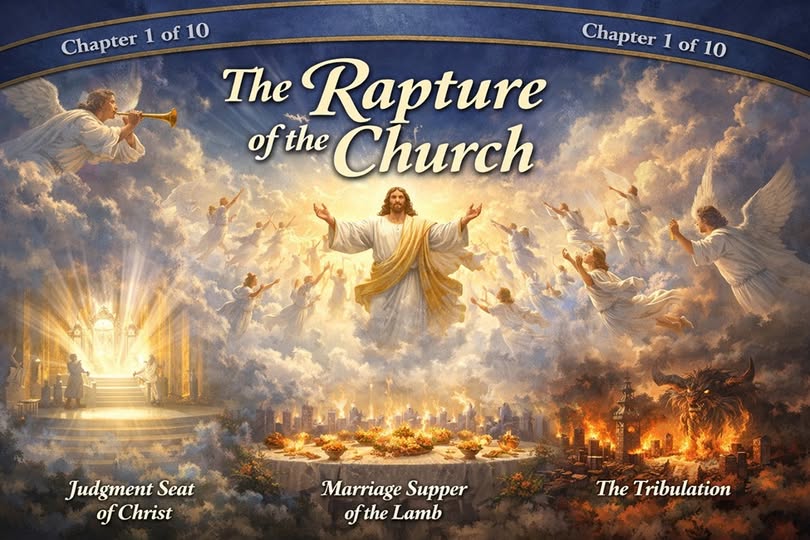
The Hope of the Believer: The Rapture and the Gathering of the Church
The Definition and Promise of the Rapture
The subject commonly called "the rapture of the church" has long been one of the most discussed doctrines in Christian eschatology. While some believers see it as a clear and central teaching of the New Testament, others interpret the prophetic passages through different lenses. Because of this diversity of views, a careful study of the Word is essential.
The word "rapture" itself d... moreThe Hope of the Believer: The Rapture and the Gathering of the Church
The Definition and Promise of the Rapture
The subject commonly called "the rapture of the church" has long been one of the most discussed doctrines in Christian eschatology. While some believers see it as a clear and central teaching of the New Testament, others interpret the prophetic passages through different lenses. Because of this diversity of views, a careful study of the Word is essential.
The word "rapture" itself does not appear in the English Bible. It is derived from the Latin rapturo, which stems from the Greek word harpazō, meaning to seize, snatch, or catch away. This term appears in 1 Thessalonians 4:17, where believers are described as being "caught up" to meet the Lord. The core of this doctrine is that all believers in Christ—both the living and the dead—will be gathered to the Lord in a sudden and supernatural event. This promise is woven through several key passages, including 1 Corinthians 15:51–58, Philippians 3:20–21, 1 Thessalonians 4:13–17, Colossians 3:4, John 14:1–3, and Luke 21:34–36.
The Biblical Description of the Gathering
One of the most vivid descriptions of this event is found in 1 Thessalonians 4:16–17:
"For the Lord himself shall descend from heaven with a shout, with the voice of the archangel, and with the trump of God: and the dead in Christ shall rise first: Then we which are alive and remain shall be caught up together with them in the clouds, to meet the Lord in the air: and so shall we ever be with the Lord."
This text outlines a specific sequence: the Lord’s descent, the resurrection of the dead in Christ, the transformation of the living, and the collective gathering in the air. Paul the Apostle further explains this as a "mystery"—a truth previously hidden but now revealed—in 1 Corinthians 15:51–52. He notes that "we shall not all sleep, but we shall all be changed, In a moment, in the twinkling of an eye, at the last trump." During this moment, the believer’s body undergoes a radical change, as "this corruptible must put on incorruption, and this mortal must put on immortality" (1 Corinthians 15:53).
Distinguishing the Rapture from the Second Coming
A major distinction is often made between the Rapture and the Second Coming of Christ to the earth. According to the pre-tribulation interpretation, these are two separate stages of Christ's return.
In the Rapture, Christ comes for His saints; they meet Him in the air, and the event is sudden and unexpected, occurring before the Great Tribulation. This is reflected in John 14:3, where Jesus promises, "I will come again, and receive you unto myself; that where I am, there ye may be also."
In the Second Coming, Christ returns with His saints to the earth (Zechariah 14:5). This event is visible to all nations and occurs after the tribulation. For example, Revelation 19:14 describes the "armies which were in heaven" following Christ on white horses. Advocates of this view conclude that the saints must already be in heaven to be able to return with Him.
However, an alternative view suggests a single return. This perspective argues that the Rapture and the Second Coming occur as one event where believers meet Christ in the air and immediately accompany Him back to earth. This view points to Matthew 24:30–31, which describes the Son of Man coming in the clouds with a trumpet to gather His elect after the tribulation. Question is, when and where did the “marriage supper of the Lamb” occur?
Revelation 19:7 says:
“The marriage of the Lamb HAS COME, and His wife HAS MADE herself ready.”
This is before Christ descends in Revelation 19:11–16.
Meaning:
• The marriage (the union of Christ and the glorified Body of Christ)
• Occurs in heaven
• After the Rapture
• After the Bema Seat (where the Bride is “arrayed in fine linen” v. 😎
The “Bride” is already glorified, rewarded, and ready before Christ returns.
So, the “marriage” itself is a heavenly, pre Second Coming event.
The Order and Purpose of the Resurrection
The Rapture serves several divine purposes: the resurrection of the righteous, the transformation of the living into immortal bodies, and the eternal fellowship of the church with Christ.
Some studies suggest that the "first resurrection" mentioned in Revelation 20:4–6 occurs in several "orders" or companies, based on 1 Corinthians 15:23: "Every man in his own order." This interpretation proposes multiple raptures or gatherings, including:
• Christ and the resurrected saints of the first century (Matthew 27:52–53).
• The Church before the tribulation.
• The 144,000 of Israel (Revelation 7; 14).
• The tribulation martyrs (Revelation 7:9–17).
• The two witnesses (Revelation 11:11–12).
Conversely, it is debatable that many scholars hold to a single resurrection of the righteous at the "last day," citing Jesus’ repeated promise in John 6:40: "I will raise him up at the last day." In this view, all believers are raised and gathered at the singular, climactic return of Christ.
Living in Expectation
Despite differing views on the exact timing of the gathering, the New Testament consistently calls the believer to a life of watchful expectation. The promise of the Rapture is intended to be a source of profound comfort and motivation. Paul concludes his teaching on the subject with an exhortation to be "stedfast, unmovable, always abounding in the work of the Lord" (1 Corinthians 15:58).
Similarly, the Apostle John notes that "every man that hath this hope in him purifieth himself" (1 John 3:3). The doctrine of the Rapture is not merely a subject for theological speculation; it is a call to holiness and readiness. Whether Christ returns today or in the future, the final message of Scripture remains a beacon of hope: "Surely I come quickly" (Revelation 22:20).
✠ Sir John Scivoletti ✠
✠ Turco Joan of Arc Priory ✠
✠✠Act and God will Act (Actus et Deus Act)✠✠