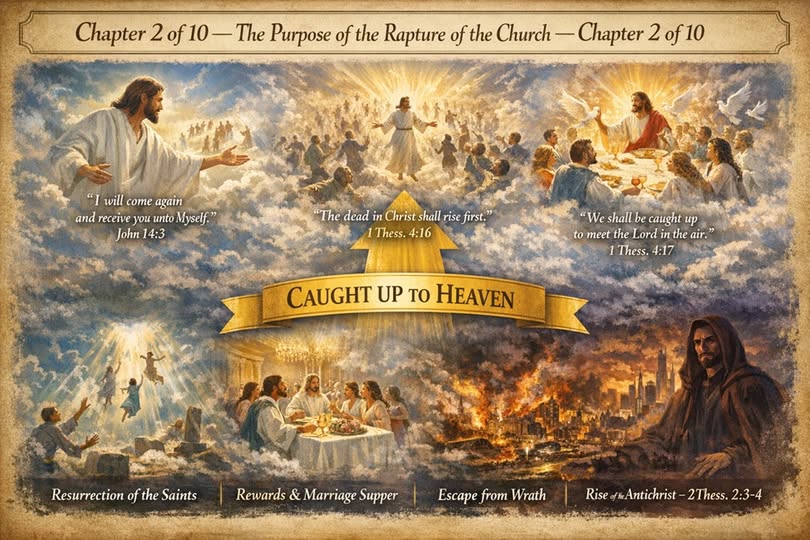
Chapter 2 of 10 - The Purpose of the Rapture
The doctrine commonly called the Rapture of the Church refers to the moment when believers are caught up to meet the Lord. The term “rapture” is derived from the Latin rapturo, which translates the Greek word harpazō, meaning to seize, catch away, or snatch up. This word appears in 1 Thessalonians 4:17, where Paul writes that believers will be “caught up together… in the clouds, to meet the Lord in the air.”
While Christians differ regarding the tim... moreChapter 2 of 10 - The Purpose of the Rapture
The doctrine commonly called the Rapture of the Church refers to the moment when believers are caught up to meet the Lord. The term “rapture” is derived from the Latin rapturo, which translates the Greek word harpazō, meaning to seize, catch away, or snatch up. This word appears in 1 Thessalonians 4:17, where Paul writes that believers will be “caught up together… in the clouds, to meet the Lord in the air.”
While Christians differ regarding the timing and nature of this event, the Scriptures provide several theological purposes for the gathering of believers to Christ. These purposes can be understood through the teachings of the New Testament, particularly in the writings of the apostle Paul and the words of Jesus Himself.
This chapter explores ten major purposes commonly associated with the Rapture. Where alternative interpretations exist among Christian traditions, those perspectives will also be considered.
1. To Receive the Saints Unto Himself
One of the clearest purposes of Christ’s return for believers is His promise to personally receive them to Himself.
Jesus gave this promise during His final discourse with His disciples:
“Let not your heart be troubled: ye believe in God, believe also in me. In my Father's house are many mansions: if it were not so, I would have told you. I go to prepare a place for you.
And if I go and prepare a place for you, I will come again, and receive you unto myself; that where I am, there ye may be also.”
— John 14:1–3
John 14:1–3 is spoken hours before He goes to Gethsemane and is arrested. It is given before the cross, but it points beyond the cross— to His ascension, heavenly ministry, and future return for His own.
It is not a Kingdom promise to Israel. It is a heavenly promise to His disciples, anticipating the Body of Christ’s heavenly destiny.
It fits perfectly with:
• The Rapture (“receive you unto Myself”)
• Our heavenly position (Ephesians 2:6)
• Our citizenship in heaven (Philippians 3:20)
Jesus is preparing a heavenly dwelling, not an earthly Kingdom mansion.
So, here Christ describes a future return in which He gathers His followers to Himself. The emphasis is relational: believers are brought into the presence of Christ.
Paul echoes this gathering when he writes:
“Now we beseech you, brethren, by the coming of our Lord Jesus Christ, and by our gathering together unto him.”
— 2 Thessalonians 2:1
In addition, the Church is portrayed as the bride of Christ, whom He intends to present to Himself in purity.
“That he might present it to himself a glorious church, not having spot, or wrinkle, or any such thing; but that it should be holy and without blemish.”
— Ephesians 5:27
Alternative Interpretation
Some interpreters understand John 14:1–3 not as a separate rapture event but as referring to the Second Coming of Christ at the end of the age, when believers meet Him as He establishes His kingdom. This contradicts that many scholars hold to a single resurrection of the righteous at the "last day," citing Jesus’ repeated promise in John 6:40: "I will raise him up at the last day." In this view, all believers are raised and gathered at the singular, climactic return of Christ.
Those who hold this view argue that the passage emphasizes Christ’s ultimate return rather than a distinct event occurring before tribulation.
However, many scholars distinguish this promise from the Second Coming because:
• Believers meet Christ in the air (1 Thess. 4:17).
• Christ receives believers to Himself, rather than immediately descending to earth.
• The focus is comfort and reunion rather than judgment.
To Resurrect the Dead in Christ
Another central purpose of the Rapture is the resurrection of believers who have died.
Paul explains that death entered the world through Adam, but resurrection comes through Christ:
“For since by man came death, by man came also the resurrection of the dead.
For as in Adam all die, even so in Christ shall all be made alive.
But every man in his own order: Christ the firstfruits; afterward they that are Christ's at his coming.”
— 1 Corinthians 15:21–23
Paul then reveals what he calls a mystery:
“Behold, I shew you a mystery; We shall not all sleep, but we shall all be changed,
In a moment, in the twinkling of an eye, at the last trump: for the trumpet shall sound, and the dead shall be raised incorruptible, and we shall be changed.”
— 1 Corinthians 15:51–52
This resurrection is also described in detail in 1 Thessalonians 4:13–17, where Paul comforts believers concerning those who have died.
“For the Lord himself shall descend from heaven with a shout, with the voice of the archangel, and with the trump of God: and the dead in Christ shall rise first.”
— 1 Thessalonians 4:16
Those who are alive are then caught up together with them.
“Then we which are alive and remain shall be caught up together with them in the clouds, to meet the Lord in the air: and so shall we ever be with the Lord.”
— 1 Thessalonians 4:17
Relation to the First Resurrection
Revelation describes a “first resurrection.”
“Blessed and holy is he that hath part in the first resurrection: on such the second death hath no power.”
— Revelation 20:6
Some interpret the resurrection at the Rapture as the beginning phase of this first resurrection, which includes multiple stages culminating with tribulation martyrs.
Alternative Interpretation
Other theologians argue that 1 Corinthians 15 and 1 Thessalonians 4 describe the same resurrection that occurs at the visible Second Coming rather than a separate event earlier in time.
They point out that the resurrection and Christ’s return are often linked together in Scripture.
However, those who distinguish the Rapture note that the passages emphasize meeting Christ in the air rather than His descent to earth.
To Bring the Saints to Heaven for Reward and Celebration
Another purpose associated with the Rapture is that believers are brought into heaven for evaluation, reward, and celebration.
Paul writes:
“For we must all appear before the judgment seat of Christ; that every one may receive the things done in his body.”
— 2 Corinthians 5:10
This judgment is not for condemnation but for reward.
Similarly, Paul states:
“When Christ, who is our life, shall appear, then shall ye also appear with him in glory.”
— Colossians 3:4
Revelation describes a great celebration in heaven known as the marriage supper of the Lamb.
“Let us be glad and rejoice, and give honour to him: for the marriage of the Lamb is come, and his wife hath made herself ready.”
— Revelation 19:7
The imagery reflects the ancient Jewish wedding pattern:
the bridegroom receives the bride and later celebrates the wedding feast.
Alternative Interpretation
Some scholars believe that the judgment seat of Christ and marriage supper occur after the Second Coming, rather than during a heavenly interval before it.
They argue that Revelation 19 places the marriage celebration immediately before Christ returns to earth.
Both interpretations recognize the same events but differ regarding their placement in the prophetic timeline.
To Transform Believers from Mortality to Immortality
The Rapture also includes the transformation of believers’ bodies.
Paul describes this dramatic change:
“For this corruptible must put on incorruption, and this mortal must put on immortality.”
— 1 Corinthians 15:53
This transformation produces a body like Christ’s resurrected body.
“Who shall change our vile body, that it may be fashioned like unto his glorious body.”
— Philippians 3:21
Paul also compares the present body to a temporary tent:
“For we know that if our earthly house of this tabernacle were dissolved, we have a building of God… eternal in the heavens.”
— 2 Corinthians 5:1
Thus, the Rapture completes the believer’s redemption by restoring the body as well as the soul.
To Present the Saints Before the Father
Christ ultimately gathers believers in order to present them before God the Father.
Paul writes:
“To the end he may stablish your hearts unblameable in holiness before God, even our Father, at the coming of our Lord Jesus Christ with all his saints.”
— 1 Thessalonians 3:13
The Church is presented as a purified bride.
“That he might present it to himself a glorious church.”
— Ephesians 5:27
The ultimate result is eternal fellowship with God.
To Perfect the Believer in Spirit, Soul, and Body
Salvation involves the complete sanctification of the believer.
Paul expresses this prayer:
“And the very God of peace sanctify you wholly; and I pray God your whole spirit and soul and body be preserved blameless unto the coming of our Lord Jesus Christ.”
— 1 Thessalonians 5:23
At the Rapture, the final stage of redemption occurs when the believer’s entire being is perfected.
To Gather the Fruit of God’s Harvest
James compares Christ’s return to a farmer gathering his harvest:
“Be patient therefore, brethren, unto the coming of the Lord.
Behold, the husbandman waiteth for the precious fruit of the earth, and hath long patience for it, until he receive the early and latter rain.”
— James 5:7
Believers are described throughout Scripture as the harvest of God’s redemptive work.
The Rapture therefore represents the moment when Christ gathers the fruit of His labor.
To Deliver Believers from the Coming Wrath
Another frequently cited purpose of the Rapture is deliverance from divine wrath.
Paul writes:
“For God hath not appointed us to wrath, but to obtain salvation by our Lord Jesus Christ.”
— 1 Thessalonians 5:9
Jesus also warned believers to remain watchful:
“Watch ye therefore, and pray always, that ye may be accounted worthy to escape all these things that shall come to pass.”
— Luke 21:36
Some interpreters therefore conclude that believers will be removed before the Tribulation period described in Revelation.
Alternative Interpretation
Others believe believers will remain on earth during tribulation but will be spiritually preserved through it, much like Israel during the plagues of Egypt.
They argue that:
• Scripture often depicts believers enduring persecution.
• Jesus speaks of tribulation affecting His followers (Matthew 24:9).
Thus, the debate centers on whether “wrath” refers to the entire tribulation period or only the final judgments of God.
To Remove the Restrainer of Lawlessness
Paul writes of a mysterious force restraining evil:
“For the mystery of iniquity doth already work: only he who now letteth will let, until he be taken out of the way.”
— 2 Thessalonians 2:7
Many interpret this restrainer as the Holy Spirit working through the Church. If so, the removal of the Church at the Rapture would allow the rise of the Antichrist.
Alternative Interpretation
Others believe the restrainer may be:
• civil government
• angelic authority
• or the sovereign timing of God
Because the text does not explicitly identify the restrainer, interpretations vary.
To Allow the Revelation of the Antichrist
Paul continues:
“And then shall that Wicked be revealed, whom the Lord shall consume with the spirit of his mouth.”
— 2 Thessalonians 2:8
Some prophetic systems therefore place the Rapture before the revelation of the Antichrist, viewing it as a necessary step in the unfolding of end-time events.
Alternative Interpretation
Other interpretations suggest that the Antichrist may appear before Christ gathers believers, arguing that believers are warned to recognize him.
The difference arises from how one understands the sequence of events in 2 Thessalonians 2 and Matthew 24.
The Rapture represents one of the most discussed and debated doctrines of biblical prophecy. Regardless of the timing interpretations, several truths remain consistent across Christian theology:
• Christ will return for His people.
• The dead in Christ will be raised.
• Believers will be transformed into immortal glory.
• They will be with the Lord forever.
As Paul concludes after describing this hope:
“Wherefore comfort one another with these words.”
— 1 Thessalonians 4:18
The doctrine of the Rapture is therefore not merely prophetic speculation; it is intended to provide hope, encouragement, and motivation for faithful living as believers await the return of their Lord.
✠ Sir John Scivoletti ✠
✠ Turco Joan of Arc Priory ✠
✠✠Act and God will Act (Actus et Deus Act)✠✠