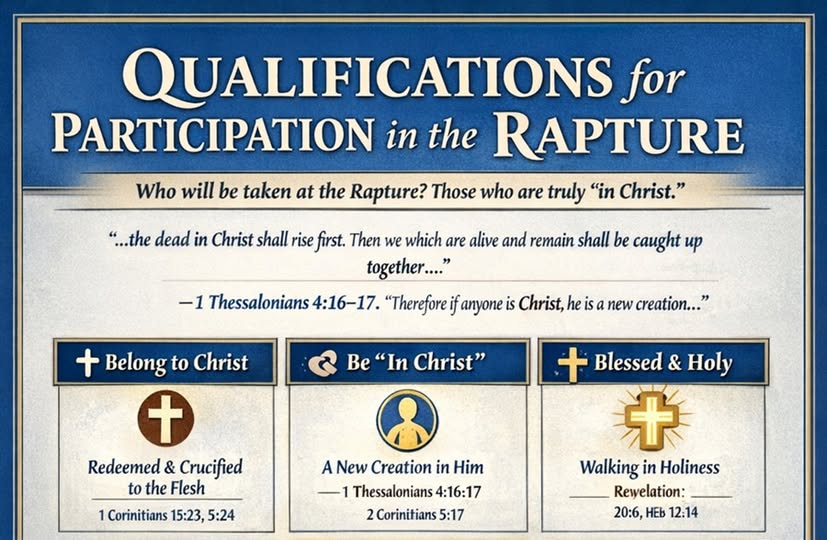
Chapter 3 of 10 — Qualifications for Participation in the Rapture
The question of who will participate in the rapture is not merely speculative—it is answered directly and repeatedly in Scripture. At its core, the Bible presents a single, foundational requirement: to be “in Christ.”
The Apostle Paul writes:
“For the Lord himself shall descend from heaven with a shout… and the dead in Christ shall rise first: Then we which are alive and remain shall be caught up together with them…”
(1 Thessa... moreChapter 3 of 10 — Qualifications for Participation in the Rapture
The question of who will participate in the rapture is not merely speculative—it is answered directly and repeatedly in Scripture. At its core, the Bible presents a single, foundational requirement: to be “in Christ.”
The Apostle Paul writes:
“For the Lord himself shall descend from heaven with a shout… and the dead in Christ shall rise first: Then we which are alive and remain shall be caught up together with them…”
(1 Thessalonians 4:16–17)
Likewise:
“Therefore, if any man be in Christ, he is a new creature…”
(2 Corinthians 5:17)
This phrase—“in Christ”—is not superficial or symbolic. It defines identity, position, and relationship. It is the dividing line between those who belong to Christ and those who do not (1 Corinthians 15:23).
Yet Scripture expands this truth in multiple ways, describing the nature and evidence of those who are truly His. These are not separate qualifications in the sense of earning salvation, but expressions of what it means to genuinely belong to Christ.
1. Belonging to Christ
“Afterward they that are Christ’s at his coming.”
(1 Corinthians 15:23)
To be “Christ’s” is to be His possession—redeemed, justified, and identified with Him. This includes a decisive break with the dominion of the flesh:
“They that are Christ’s have crucified the flesh with the affections and lusts.”
(Galatians 5:24)
This crucifixion is not perfection in behavior, but a real transformation of allegiance.
2. Being “In Christ”
The rapture explicitly concerns those “in Christ”—both the dead and the living (1 Thessalonians 4:16–17).
To be “in Christ” is to be united with Him through faith, sharing in His death and resurrection (Romans 6:3–5). It is a spiritual position that produces a new life:
“Old things are passed away; behold, all things are become new.”
(2 Corinthians 5:17)
3. Blessed and Holy
“Blessed and holy is he that hath part in the first resurrection…”
(Revelation 20:6)
Holiness is not optional:
“Without holiness no man shall see the Lord.”
(Hebrews 12:14)
This holiness is both positional (given in Christ) and practical (worked out in life).
4. A Life That Reflects Good
Jesus declared:
“They that have done good, unto the resurrection of life…”
(John 5:29)
This does not teach salvation by works, but rather that works reveal the nature of the heart (James 2:17–18). Good works are evidence of genuine faith.
5. Coming Through Christ Alone
“I am the way, the truth, and the life: no man cometh unto the Father, but by me.”
(John 14:6)
Participation in the rapture is exclusively through Jesus Christ. There is no alternate path, no secondary qualification, and no substitute.
6. Watchfulness and Worthiness
“Watch ye therefore, and pray always, that ye may be accounted worthy to escape…”
(Luke 21:36)
This introduces the concept of readiness—a life lived in expectation of Christ’s return.
7. Membership in the Body of Christ
“For by one Spirit are we all baptized into one body…”
(1 Corinthians 12:13)
The Church—the Body of Christ—is composed of all true believers (Ephesians 1:22–23). The rapture, in this framework, is the gathering of that body to Christ.
8. A Life of Purification
“Every man that hath this hope in him purifieth himself…”
(1 John 3:3)
The expectation of Christ’s return produces a life marked by:
• Walking in the light (1 John 1:7)
• Separation from sin (2 Corinthians 7:1)
• Life in the Spirit (Galatians 5:16–26)
9. Without Spot or Blemish
“A glorious church… holy and without blemish.”
(Ephesians 5:27)
This ultimately points to Christ’s sanctifying work. The Church is made pure not by its own merit, but by His cleansing.
The Heart of the Matter: The New Birth
The Scriptures consistently emphasize that external religion is not enough.
Jesus warned:
“That which cometh out of the man, that defileth the man…”
(Mark 7:20–23)
Outward morality, religious activity, or cultural Christianity cannot replace true regeneration.
Paul affirms:
“The Spirit itself beareth witness with our spirit, that we are the children of God.”
(Romans 8:16)
The issue is not outward reform, but inward transformation.
Are These Requirements or Evidences?
• Only those actively walking in holiness and purity at the time of the rapture will be taken.
• Others, though perhaps previously exposed to truth, will remain and later be saved during the Tribulation.
This reflects a conditional readiness model, where participation depends on spiritual condition at that moment.
Alternative Interpretation (Mainstream View)
Many theologians understand these passages differently:
1. All True Believers Are Included
The dominant interpretation of passages like 1 Thessalonians 4:16–17 is that all who are “in Christ” are taken, not a subset based on spiritual performance.
2. Holiness as Evidence, Not a Threshold
Holiness and good works are seen as:
• Evidence of salvation
• Not conditions for inclusion in the rapture
3. No Partial Rapture
The idea that some true believers are left behind (often called the partial rapture theory) is generally rejected because:
• Scripture consistently speaks of a unified resurrection and gathering (1 Corinthians 15:51–52)
• The Church is presented as a complete body, not divided at His coming
4. Tribulation Saints
Those saved during the Tribulation (Revelation 7:14) are typically understood not as previously unready believers, but as new converts who come to faith after the rapture.
Why the Difference Matters
• Personal holiness
• Readiness
• Watchfulness
These are unquestionably biblical and vital.
However, the alternative view emphasizes:
• Assurance rooted in Christ’s finished work
• Unity of the Church
• Salvation by grace apart from performance (Ephesians 2:8–9)
The Time and Imminence of the Rapture
Scripture does not give a specific time. However, it emphasizes imminence:
“Looking for that blessed hope…”
(Titus 2:13)
The early Church lived in expectation (Philippians 3:20–21), suggesting that no prerequisite events must occur first.
The Practical Power of This Doctrine
The doctrine of the Lord’s coming is not merely prophetic—it is deeply practical. It produces:
• Holiness (1 John 3:3)
• Watchfulness (Matthew 24:42)
• Patience (James 5:7–8)
• Endurance (1 Peter 1:7)
• Hope (1 Corinthians 15)
The rapture represents the believer’s entrance into eternal joy, while the second coming establishes Christ’s reign on earth (Revelation 11:15).
Final Reflection
At its core, the question is not merely “Will I qualify?” but rather:
“Am I truly in Christ?”
For if a man is in Christ:
• He is a new creation
• He belongs to Christ
• He walks in the light
• And he awaits His appearing
And when that moment comes:
“We shall be changed… and so shall we ever be with the Lord.”
(1 Corinthians 15:51–52; 1 Thessalonians 4:17)
✠ Sir John Scivoletti ✠
✠ Turco Joan of Arc Priory ✠
✠✠Act and God will Act (Actus et Deus Act)✠✠