The Divine Pause: A Study of Revelation Chapter 7
Between the breaking of the sixth and seventh seals, the chronological narrative of judgment momentarily halts. Chapter 6 ended with a terrifying question from a trembling world: "For the great day of his wrath is come; and who shall be able to stand?" Chapter 7 serves as a divine parenthetical, an explanatory vision inserted by the Spirit to answer that very question. Before the Seventh Seal unleashes the next wave of escalation, Heaven reveals... moreThe Divine Pause: A Study of Revelation Chapter 7
Between the breaking of the sixth and seventh seals, the chronological narrative of judgment momentarily halts. Chapter 6 ended with a terrifying question from a trembling world: "For the great day of his wrath is come; and who shall be able to stand?" Chapter 7 serves as a divine parenthetical, an explanatory vision inserted by the Spirit to answer that very question. Before the Seventh Seal unleashes the next wave of escalation, Heaven reveals that even in the midst of global upheaval, God is busy marking, protecting, and redeeming His own. Two distinct companies are shown to "stand" before the Lord.
I. The Sealing of the 144,000 (7:1–8)
The vision begins with a scene of restrained power. John sees four angels standing at the "four corners" of the earth, holding back the winds of judgment. A fifth angel ascends from the east, carrying the seal of the living God. The command is clear: no further destruction can be released upon the earth, the sea, or the trees until the servants of God are sealed in their foreheads.
The Identity of the Sealed John hears the specific number of those sealed: 144,000, comprised of 12,000 individuals from each of the twelve tribes of Israel. The list includes Judah, Reuben, Gad, Asher, Naphtali, Manasseh, Simeon, Levi, Issachar, Zebulun, Joseph, and Benjamin.
In a literal, futurist framework, this is understood as a literal Jewish remnant. These are ethnic Israelites who are supernaturally protected after the Church has been raptured. They are marked for preservation through the coming trumpet judgments.
It is noteworthy that the tribe of Dan is omitted from this list, while Ephraim is likely represented under the name of Joseph. In biblical history, both tribes were heavily associated with the introduction of idolatry into Israel, and their omission here may signify a specific judicial pruning of the tribal rolls during this final period of testing.
The Nature of the Seal While some interpret this seal as purely spiritual, a literal reading suggests a visible mark of ownership. Just as the "Mark of the Beast" in Chapter 13 is a literal requirement for commerce, God’s seal is a literal mark of allegiance. This is supported by Chapter 9:4, where demonic "locusts" are commanded not to harm those who have the seal of God on their foreheads. The seal signifies that these 144,000 are God’s "special forces"—divinely commissioned and physically preserved witnesses in a rebellious world.
II. The Great Multitude (7:9–17)
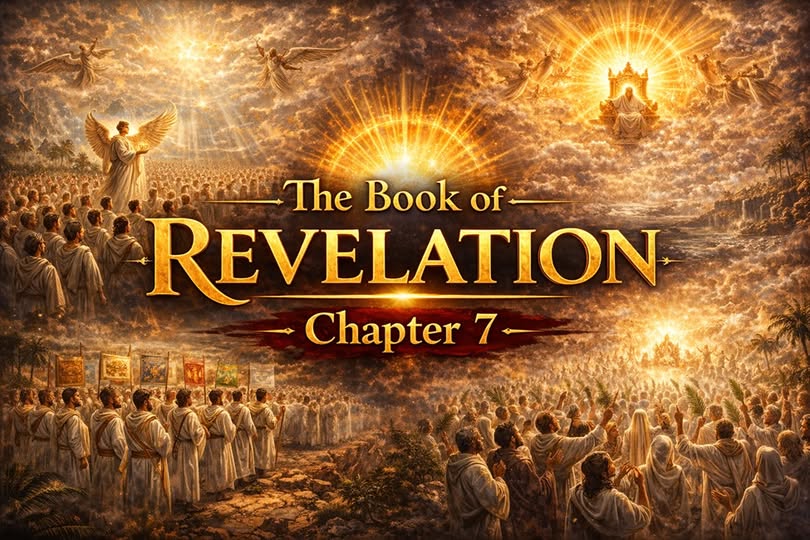
Immediately after hearing the census of the 144,000, John’s vision expands. He sees an innumerable multitude from every nation, kindred, people, and tongue. Unlike the first group, which was numbered and specifically Israelite, this group is universal and countless. They stand before the throne clothed in white robes, holding palm branches, and crying, "Salvation to our God... and unto the Lamb."
The Great Tribulation Saints When asked who these people are, the elder explains: "These are they which came out of great tribulation, and have washed their robes, and made them white in the blood of the Lamb."
There is a significant interpretive discussion regarding the relationship between the two groups. Many see them as two separate companies: the 144,000 being a protected Jewish remnant on earth, and the great multitude being the martyred saints of all nations who have arrived in heaven. Others suggest they are the same group viewed from different perspectives—John first "hears" the census of Israel, but then "sees" the global, spiritual reality of the redeemed.
Regardless of the structural distinction, the theological message is identical. These individuals are not part of the Church Age; they are those who turn to Christ during the Tribulation. They represent the greatest harvest of souls in human history, occurring during the world's darkest hour.
The Pastoral Comfort of Chapter 7
Chapter 7 provides a profound shift in tone. While Chapter 6 focused on the "Wrath of the Lamb," Chapter 7 focuses on the Shepherding of the Lamb.
The passage concludes with a beautiful description of the heavenly state for these redeemed sufferers. They serve God day and night in His temple, and "He that sitteth on the throne shall dwell among them." They shall no longer hunger or thirst, nor shall the sun strike them with heat.
The most moving promise is found in the final verse: "The Lamb which is in the midst of the throne shall feed them, and shall lead them unto living fountains of waters: and God shall wipe away all tears from their eyes."
Theological Significance
The placement of this chapter proves that judgment never moves forward without mercy being marked. Before the Seventh Seal is broken—which will launch the terrifying Trumpet judgments—God pauses the narrative to show John (and us) that His grace is still active.
• God Marks: He knows exactly who belongs to Him.
• God Preserves: He can protect His servants in the midst of fire.
• God Redeems: The blood of the Lamb is sufficient even for those who missed the Rapture but find faith in the fire.
• God Shepherds: The same Lamb who breaks the seals of judgment is the Shepherd who wipes away the tears of the suffering.
The question of "Who can stand?" has been answered. It is not the strong, the rich, or the mighty who stand; it is the sealed and the washed.
✠SGT Dinah Scivoletti✠
✠Joan of Arc Priory✠
✠✠Act and God will Act (Actus et Deus Act)✠✠