The Measuring Rod and the Two Witnesses: A Study of Revelation Chapter 11
Revelation Chapter 11 serves as a bridge between the trumpet judgments and the final transition of world power. In the previous chapter, John was told he must "prophesy again," and here the content of that prophecy begins to manifest in the very heart of the holy city, Jerusalem. This chapter captures the collision between the kingdom of man and the kingdom of God, featuring supernatural ministry, temporary martyrdom, and... moreThe Measuring Rod and the Two Witnesses: A Study of Revelation Chapter 11
Revelation Chapter 11 serves as a bridge between the trumpet judgments and the final transition of world power. In the previous chapter, John was told he must "prophesy again," and here the content of that prophecy begins to manifest in the very heart of the holy city, Jerusalem. This chapter captures the collision between the kingdom of man and the kingdom of God, featuring supernatural ministry, temporary martyrdom, and a heavenly coronation.
The Measuring of the Temple (11:1–2)
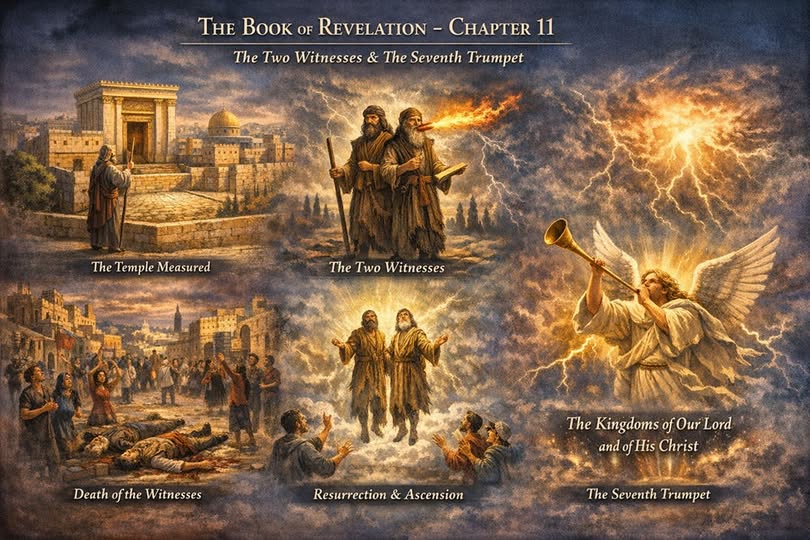
John is handed a reed like a measuring rod and told to perform a symbolic act: he is to measure the temple of God, the altar, and the worshippers. In biblical prophecy, "measuring" signifies divine ownership and assessment. God is marking out what is His, signaling that despite the surrounding chaos, He has not forgotten His covenant dwelling place.
However, John is told to exclude the outer court, for it has been given over to the Gentiles to tread underfoot for forty-two months. This period—equivalent to three and a half years—aligns with the "Great Tribulation" or the second half of Daniel’s 70th Week. This passage confirms that a literal temple will once again stand in Jerusalem during this time, serving as a focal point for the final spiritual conflict between the Antichrist and the true God.
The Two Witnesses: Fire and Prophecy (11:3–6)
In the midst of this spiritual occupation, God raises up two "witnesses" to whom He gives supernatural power. They are dressed in sackcloth, signifying a message of mourning and repentance. For 1,260 days (the same three-and-a-half-year period), they stand as the light of truth in a world shrouded in deception.
John describes them as "two olive trees and two lampstands." This imagery, rooted in the book of Zechariah, points to individuals empowered by the Holy Spirit to accomplish an impossible task. Their authority is immense:
• They are divinely protected; if anyone seeks to harm them, fire proceeds from their mouths to consume their enemies.
• They have power over the elements, shutting the heavens so it does not rain, turning water into blood, and striking the earth with plagues at will.
Because their miracles mirror those of Moses (turning water to blood/plagues) and Elijah (calling down fire/stopping rain), many believe these are the literal prophets of old returned to fulfill a final mission. Others suggest they are Elijah and Enoch, the two men in history who never saw death. Regardless of their names, they represent God’s refusal to leave the world without a witness.
Martyrdom, Mockery, and Miracle (11:7–13)
When their testimony is finished—and not a moment before—God allows the "beast that ascends out of the bottomless pit" (the Antichrist) to make war against them. This is the first mention of the Beast in Revelation, and he is permitted to overcome and kill the two prophets.
The world’s reaction is a staggering display of depravity. The bodies of the witnesses are left in the streets of Jerusalem, which is spiritually likened to Sodom and Egypt. For three and a half days, the inhabitants of the earth watch their remains. Rather than mourning, the world throws a global party, sending gifts to one another in celebration of the deaths of these "tormentors." The truth was so painful to their consciences that they treated its silencing as a holiday.
But the celebration is cut short. After three and a half days, the "breath of life from God" enters them, and they stand to their feet. In full view of their terrified enemies, a voice from heaven cries, "Come up hither," and they ascend in a cloud. Immediately, a great earthquake strikes Jerusalem, destroying a tenth of the city and killing seven thousand people. For a brief moment, the survivors are struck with the fear of God.
The Seventh Trumpet: The Kingdom Proclaimed (11:14–19)
With the second woe past, the seventh angel sounds his trumpet. This trumpet is unique; it does not introduce a specific plague like the others, but rather a cosmic decree. Loud voices in heaven announce:
"The kingdoms of this world are become the kingdoms of our Lord, and of his Christ; and he shall reign for ever and ever."
The twenty-four elders fall on their faces, worshiping the God who has "taken His great power" to reign. They acknowledge that while the nations are angry, the time has come for judgment and reward. The seventh trumpet serves as the formal "legal" transfer of power; though the final bowls of wrath are yet to be poured out, the victory is now declared as an accomplished fact.
The chapter closes with the opening of the temple of God in heaven. The Ark of His Testament is seen—a powerful reminder of God’s unbreakable faithfulness to His promises. The vision ends with lightning, voices, thunderings, and great hail, signaling that the final phase of the world’s reclamation has begun.
Theological Significance
• The Witness Remains: No matter how dark the age, God provides a voice for Truth.
• The World’s Hatred: Truth is a "torment" to those who love their sin.
• God’s Vindication: The world may celebrate the "death" of truth, but God always has the final word through resurrection.
• The Certainty of Christ’s Reign: The seventh trumpet ensures that the usurper’s time is over. The King is coming to claim His own.
✠SGT Dinah Scivoletti✠
✠Joan of Arc Priory✠
✠✠Act and God will Act (Actus et Deus Act)✠✠