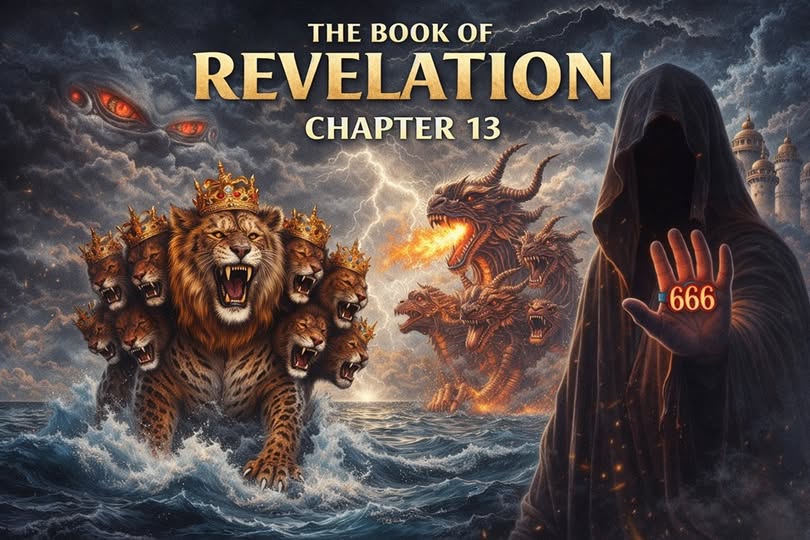
The Book of Revelation
Chapter 13 – The Extent of the Beast’s Authority
After introducing the Beast from the sea, the prophecy continues by describing the scope of his authority and the persecution that will follow.
John writes:
“And it was given unto him to make war with the saints, and to overcome them: and power was given him over all kindreds, and tongues, and nations.”
(Revelation 13:7)
This statement raises an important interpretive question: Does this mean the Antichrist will litera... moreThe Book of Revelation
Chapter 13 – The Extent of the Beast’s Authority
After introducing the Beast from the sea, the prophecy continues by describing the scope of his authority and the persecution that will follow.
John writes:
“And it was given unto him to make war with the saints, and to overcome them: and power was given him over all kindreds, and tongues, and nations.”
(Revelation 13:7)
This statement raises an important interpretive question: Does this mean the Antichrist will literally rule every nation and every individual on earth?
Many interpreters assume that the Beast becomes a complete global dictator, but a careful comparison with other prophetic passages suggests that the expression may be limited in scope according to the biblical use of universal language.
The Biblical Use of Universal Language
Throughout Scripture, words such as all, every, or the whole world are sometimes used figuratively to describe a very large portion rather than absolute universality.
Examples appear throughout both Testaments.
In the days of Noah, God declared:
“I… do bring a flood of waters upon the earth, to destroy all flesh.”
(Genesis 6:17)
Yet Noah and those within the ark survived (Genesis 7:23).
When Jericho was destroyed we read:
“They utterly destroyed all that was in the city.”
(Joshua 6:21)
Yet Rahab and her household were spared (Joshua 6:22–25).
Similarly, when Caesar Augustus issued a decree:
“That all the world should be taxed.”
(Luke 2:1)
The decree applied only to the Roman Empire, not to every nation on earth.
Even the Apostle Paul could say that the gospel had been proclaimed:
“To every creature which is under heaven.”
(Colossians 1:23)
Yet the gospel clearly had not reached every tribe or continent at that time.
These examples demonstrate that biblical writers often use universal expressions to refer to the full extent of a particular realm or empire, not necessarily the entire globe.
The Ten Kingdoms of the Final Empire
Scripture provides additional clues regarding the geographical limits of the Beast’s political authority.
In Book of Daniel, the final world empire is represented by a beast with ten horns.
Daniel writes:
“The ten horns out of this kingdom are ten kings that shall arise.”
(Daniel 7:24)
The same symbolism appears in the Book of Revelation:
“The ten horns which thou sawest are ten kings… These shall give their power and strength unto the beast.”
(Revelation 17:12–13)
These passages suggest that the Beast’s primary authority rests upon a confederation of ten kings, commonly understood as a revived/revised political structure emerging from the territory of the ancient Roman Empire.
The Antichrist rises from within this system and eventually dominates it, even overthrowing three of the kings (Daniel 7:8, 24).
The Duration of the Beast’s Dominion
The reign of the Beast is strictly limited by divine decree.
John records:
“Power was given unto him to continue forty and two months.”
(Revelation 13:5)
This period corresponds to:
• Three and one-half years
• 1,260 days
• A time, times, and half a time
These expressions appear repeatedly in prophetic passages:
• Daniel 7:25
• Daniel 12:7
• Revelation 11:2–3
• Revelation 12:6, 14
• Revelation 13:5
This period represents the final half of Daniel’s Seventieth Week (Daniel 9:27), commonly referred to as the Great Tribulation.
Nations Outside the Beast’s Control
Additional prophecies indicate that not every nation will fall completely under the authority of the Antichrist.
Daniel records that when the king of the north advances into the land:
“These shall escape out of his hand, even Edom, and Moab, and the chief of the children of Ammon.”
(Daniel 11:41)
Other nations will oppose him militarily:
“Tidings out of the east and out of the north shall trouble him.”
(Daniel 11:44)
These passages imply that independent powers still exist, even during the height of the Beast’s reign.
This also explains why demonic spirits later go out:
“To the kings of the earth and of the whole world, to gather them to the battle of that great day of God Almighty.”
(Revelation 16:14)
If every king were already under the Antichrist’s direct control, such supernatural persuasion would be unnecessary.
Survivors of the Tribulation
Another important consideration concerns the population of the Millennial Kingdom.
Jesus taught that when He returns:
“Before him shall be gathered all nations: and he shall separate them one from another, as a shepherd divideth his sheep from the goats.”
(Matthew 25:32)
Some nations are called:
“Blessed of my Father… inherit the kingdom.”
(Matthew 25:34)
If every person on earth were either killed for refusing the mark or eternally condemned for taking it, there would be no surviving nations to enter the Millennium.
Yet numerous prophecies describe nations continuing into Christ’s kingdom:
• Isaiah 2:2–4
• Zechariah 14:16–21
• Daniel 7:27
This indicates that many people will survive the tribulation without submitting to the Beast.
The Second Beast – The False Prophet
Revelation 13 introduces a second figure who plays a crucial role in the final world system.
John writes:
“And I beheld another beast coming up out of the earth.”
(Revelation 13:11)
Unlike the first beast, who represents political authority, this second beast functions primarily in a religious role.
Later Scripture identifies him explicitly:
“The false prophet.”
(Revelation 16:13; 19:20; 20:10)
His Deceptive Appearance
The second beast has:
“Two horns like a lamb, and he spake as a dragon.”
(Revelation 13:11)
His lamb-like appearance suggests religious gentleness, while his speech reveals his true allegiance to the dragon—Satan.
Through this deception he becomes the chief religious’ promoter of the Antichrist’s regime.
His Miraculous Signs
The false prophet performs astonishing miracles.
John writes:
“He doeth great wonders, so that he maketh fire come down from heaven on the earth in the sight of men.”
(Revelation 13:13)
These signs are intended to deceive the inhabitants of the earth.
Paul had already warned of such deception in the Second Epistle to the Thessalonians:
“Whose coming is after the working of Satan with all power and signs and lying wonders.”
(2 Thessalonians 2:9)
The Image of the Beast
The false prophet commands the people to construct an image of the Beast.
“He had power to give life unto the image of the beast.”
(Revelation 13:15)
This image is set up in the temple, fulfilling the prophecy spoken by Jesus concerning:
“The abomination of desolation.”
(Matthew 24:15)
Those who refuse to worship the image face execution.
The Mark of the Beast
The second beast also enforces an economic system tied to loyalty to the Antichrist.
“He causeth all… to receive a mark in their right hand, or in their foreheads.”
(Revelation 13:16)
Without this mark:
“No man might buy or sell.”
(Revelation 13:17)
Three identifiers are mentioned:
1. The mark
2. The name of the beast
3. The number of his name
The number is given as:
“Six hundred threescore and six.”
(Revelation 13:18)
Scripture warns that anyone who receives the mark will face severe judgment:
“The same shall drink of the wine of the wrath of God.”
(Revelation 14:9–10)
The Final Fate of the Beast and False Prophet
Despite their terrifying authority, the rule of the Beast and the False Prophet ends abruptly when Christ returns.
John records:
“The beast was taken, and with him the false prophet… These both were cast alive into a lake of fire burning with brimstone.”
(Revelation 19:20)
Their defeat marks the end of the final rebellion of human government against God.
✠SGT Dinah Scivoletti✠
✠Joan of Arc Priory✠
✠✠Act and God will Act (Actus et Deus Act)✠✠