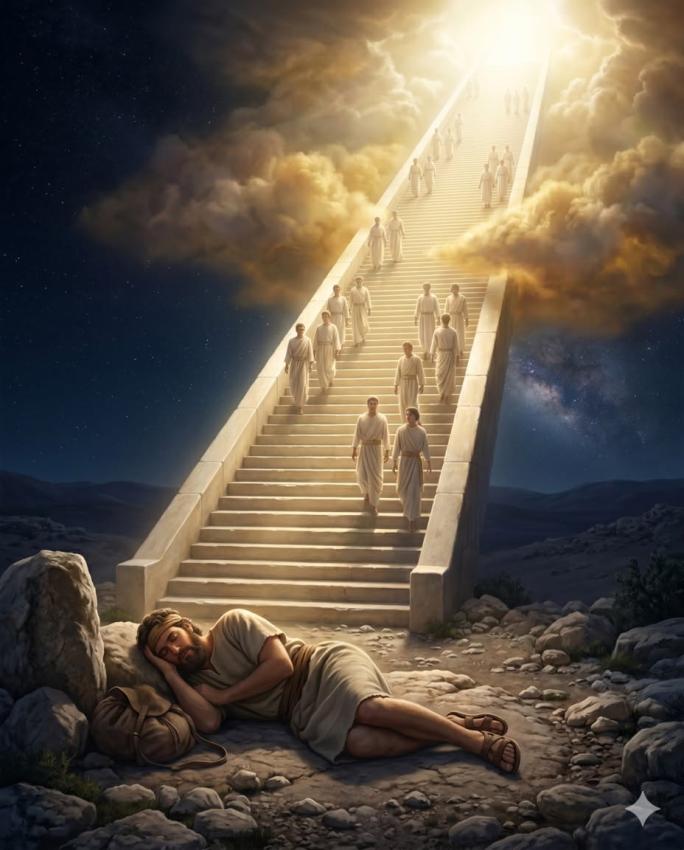
⭐ Genesis 28:16-17 records Jacob's response to waking from the Bethel dream with a declaration that has defined the theology of sacred space in Judaism and Christianity ever since — "Surely the Lord is in this place, and I did not know it." And he was afraid and said, "How awesome is this place! This is none other than the house of God, and this is the gate of heaven!" The Lord is in this place, and I did not know it. The most significant theological truth Jacob speaks in the entire narrative of... more⭐ Genesis 28:16-17 records Jacob's response to waking from the Bethel dream with a declaration that has defined the theology of sacred space in Judaism and Christianity ever since — "Surely the Lord is in this place, and I did not know it." And he was afraid and said, "How awesome is this place! This is none other than the house of God, and this is the gate of heaven!" The Lord is in this place, and I did not know it. The most significant theological truth Jacob speaks in the entire narrative of his life is spoken about a stretch of ordinary hillside in the Canaanite highlands where he stopped to sleep because he was tired. There was no temple here. No sacred precinct. No previous tradition of holy ground. Just stones and thorns and the cold of a Judean hill night, and a man who lay down as a fugitive and woke up at the gate of heaven. The gate of heaven is not where you expect to find it. It is where God decides to stand when you happen to stop. 🔱
The New Testament's interpretation of Jacob's ladder in John 1:51 is one of the most theologically dense single verses in the entire Gospel of John — and Jesus delivers it to Nathanael immediately after identifying him as "an Israelite indeed in whom is no deceit," a description that is itself a reference to Jacob, the deceiver whose name was changed to Israel. "Most assuredly, I say to you, hereafter you shall see heaven open, and the angels of God ascending and descending upon the Son of Man." Jesus is not using Jacob's ladder as a metaphor — He is identifying Himself as its fulfillment. He is the staircase. The permanent, incarnate, flesh-and-bone connection between heaven and earth that Jacob's vision showed in architectural form, Jesus announces in biographical form: I am the ladder. The angels ascending and descending on the Son of Man are operating the same route Jacob saw, but the route is now not a cosmic structure in a dream — it is a Person walking the roads of Galilee. For end times believers in whom the Spirit of God dwells, this theology is not historical interest but present reality — the gate of heaven is not a location but a relationship, and the staircase between earth and heaven is not a structure to find but a Person to know.
💬 Drop "THE LORD IS IN THIS PLACE" in the comments — Jacob's declaration of the discovered presence, the specific articulation of a person who has just learned that the ordinary ground of their journey has always been holy ground and that the God they thought was somewhere else has been present in the place where they stopped — if you have ever woken from a difficult season to discover that the God you thought was absent was precisely present in the specific stretch of ordinary ground where you laid your head down, and that the stone you happened to sleep on was the foundation of something sacred. Share this image with someone who is in an ordinary or difficult stretch of life right now — a stretch that feels unceremonious, unremarkable, and unholy — and needs to hear that the gate of heaven is located on exactly this kind of ground, and that the Lord is in this place even when we did not know it. Follow this page for daily end times truth, Genesis-to-Revelation covenant theology, and the Jacob's-ladder perspective that finds the gate of heaven not in the spectacular and the special but in the ordinary and the specific — wherever God decides to stand when you happen to stop. 👇🔥
✠1SGT Dinah Scivoletti✠
✠Joan of Arc Priory✠
✠✠Act and God will Act (Actus et Deus Act)✠✠