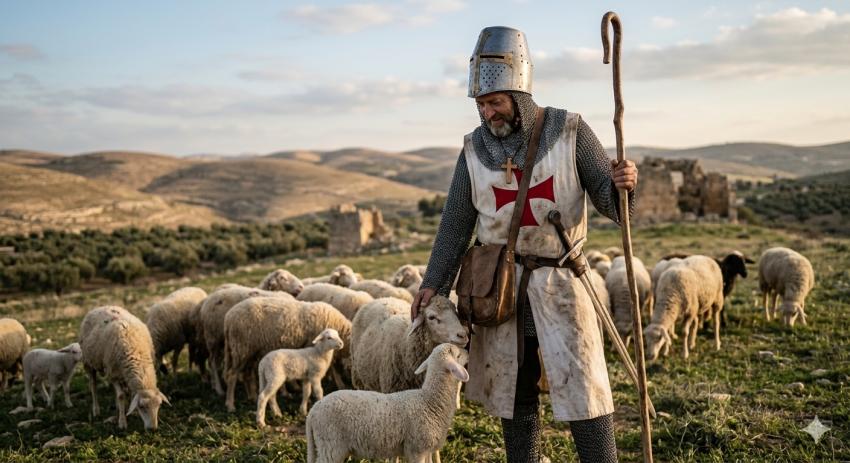
The 4th Sunday of Easter, traditionally known as Good Shepherd Sunday, centers on the profound imagery of Christ as the guardian who lays down his life for his flock. For the Knights Templar, this message was not merely a pastoral metaphor but a theological mandate for their dual identity as monks and soldiers. They saw themselves as the "watchmen on the walls," echoing the sacrificial commitment found in John 10:11: "I am the good shepherd. The good shepherd lays down his life for the sheep." J... moreThe 4th Sunday of Easter, traditionally known as Good Shepherd Sunday, centers on the profound imagery of Christ as the guardian who lays down his life for his flock. For the Knights Templar, this message was not merely a pastoral metaphor but a theological mandate for their dual identity as monks and soldiers. They saw themselves as the "watchmen on the walls," echoing the sacrificial commitment found in John 10:11: "I am the good shepherd. The good shepherd lays down his life for the sheep." Just as the Shepherd does not flee when the wolf comes, the Templars viewed their military service in the Holy Land as the ultimate act of Caritas (charity)—a willingness to endure martyrdom to protect the vulnerable pilgrims and the sacred sites of the faith.
Theologically, the Templars aligned their mission with Christ’s authority to "lay down his life and take it up again," viewing their own mortality through the lens of the Resurrection. Their patron, St. Bernard of Clairvaux, famously noted that for a Templar, death was a gain because it united the soldier with his Lord. This reflects the message of John 10:18: "No one takes it from me, but I lay it down of my own accord." By embracing the "Poor Knights" lifestyle, they rejected the hireling’s cowardice, grounding their military prowess in the spiritual conviction that true leadership and protection require a total gift of self. For the Templar, the sword was only as strong as the shepherd’s heart behind it, dedicated to the preservation of the "fold" against all spiritual and physical shadows.