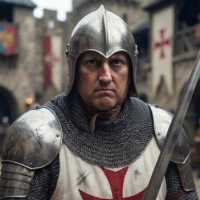
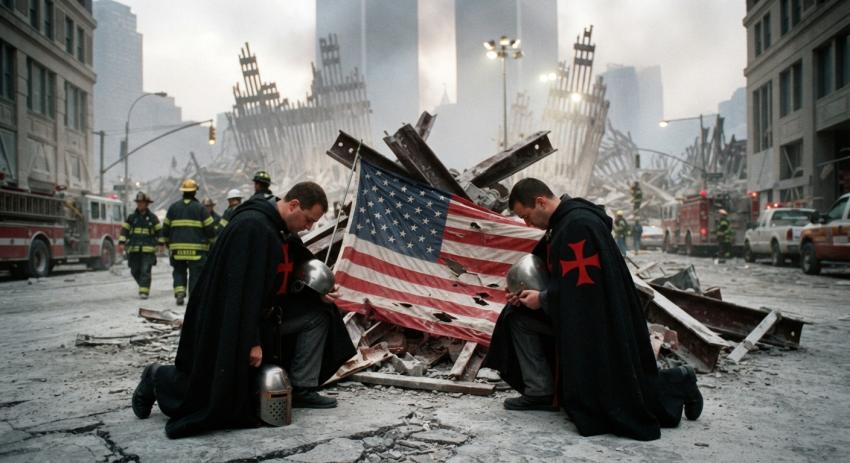
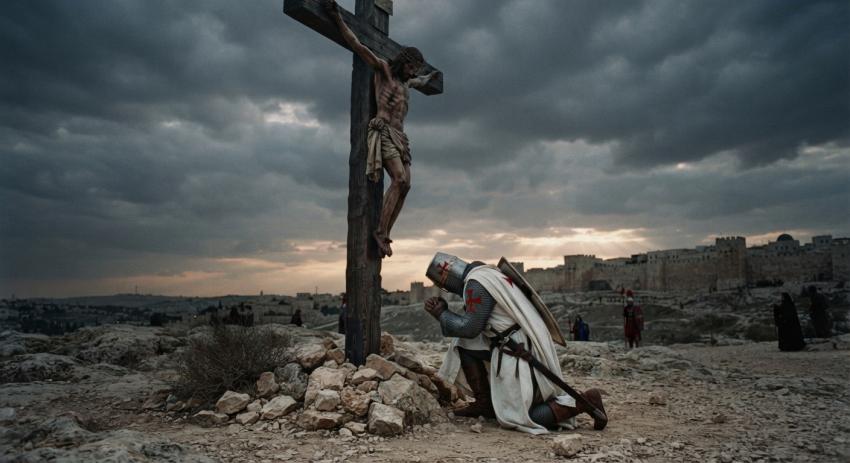
A full twenty-five years have now passed since the morning the sky fell, a milestone that transformed what was once a raw, immediate trauma into a permanent chapter of our national inheritance. For many of us, the memories of September 11, 2001, remain etched in our souls with absolute clarity—the smoke, the sirens, and the sudden, aching silence. Yet, we must recognize that an entire generation has now come of age with no personal memory of that world-shaking day. As Knights of the Temple, our ... moreA full twenty-five years have now passed since the morning the sky fell, a milestone that transformed what was once a raw, immediate trauma into a permanent chapter of our national inheritance. For many of us, the memories of September 11, 2001, remain etched in our souls with absolute clarity—the smoke, the sirens, and the sudden, aching silence. Yet, we must recognize that an entire generation has now come of age with no personal memory of that world-shaking day. As Knights of the Temple, our charge in 2026 is not merely to look backward in grief, but to stand as living sentinels of memory, ensuring that the legacy of the fallen is faithfully passed to the future generations of our nation.
In the immediate crucible of that tragedy, the ancient vows of our Order—defense of the faith, protection of the vulnerable, and unwavering fidelity to Christ—were not just abstract ideals; they became a vital spiritual armor for a wounded nation. We remember the heroes who ran toward the smoke that day and perished, embodying the ultimate measure of our fractured world's need for Christ-like sacrifice. From the immediate mobilization of aid to the quiet, enduring care given to the widows, widowers, and their children, our chivalric brotherhood answered transnational hatred with an outpouring of steadfast love. This anniversary reminded us that true honor is not defined by worldly power alone, but by a fierce, sworn commitment to defend one another. It calls us to embody the truth of Greater Love, as spoken in the Gospel of John, that:
"No one has greater love than this, to lay down one’s life for one’s friends." (John 15:13)
Twenty-five years later, America is in need of a deep spiritual reckoning. The passage of time can breed a dangerous complacency, allowing the profound national unity we felt in the wake of the attacks to erode into division, discord, and tribalism. Our culture often forgets that the strength of a nation lies not in its economic skyscrapers or its military fortresses, but in its moral fiber and its reliance on the Almighty. As Christian knights, we are called to lead our families and communities back to the bedrock of faith, reminding a wandering world that true security is found only under the shadow of the Most High. We must be the architects of a peace built on justice, keeping alive the sacred duty of prayer and vigilance for the victims and heroes of September 11th.
Therefore, let us come together with a renewed resolve to truly "Never Forget"—not just the horror of the towers falling, but the beauty of a nation rising in solidarity. Let us honor the nearly three thousand innocent souls lost, the first responders whose sacrifice still echoes, and those who continue to succumb to the lingering illnesses of Ground Zero.
As we look ahead to the next quarter-century, let us arm ourselves with the resilience of the scriptures, standing firm as protectors of our faith and our country. We draw our final strength from the words of the Prophet Isaiah, a timeless mandate for a nation that has walked through the fire and continues to look toward the eternal dawn:
"But those who wait for the Lord shall renew their strength, they shall mount up with wings like eagles, they shall run and not be weary, they shall walk and not faint." (Isaiah 40:31)
Non Nobis Domine, Non Nobis, Sed Nomini Tuo Da Gloriam!
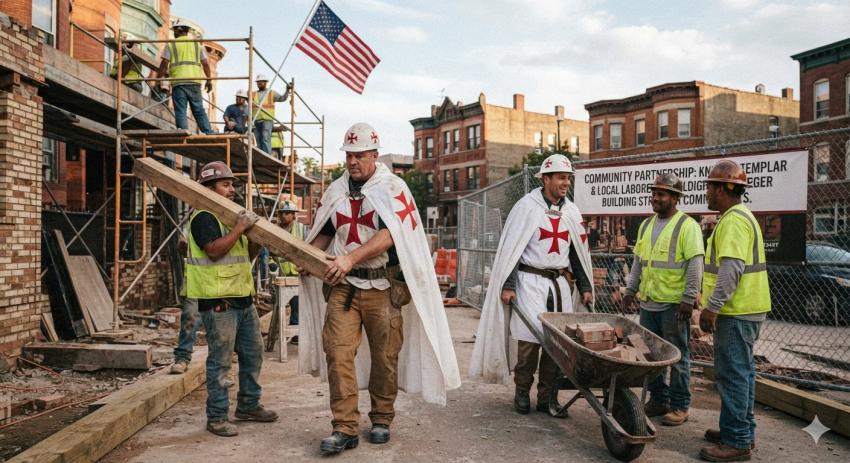
As modern Knights Templar operating not with physical swords but with the armor of faith in a digital age, we view American Labor Day through a lens of spiritual warfare and sacred duty, anchoring our reflection in Genesis 2:15, where God commanded humanity to "cultivate and care" for the earth. Labor is not a curse of the fall, but an original, noble mandate; however, in a hyper, secularized, capitalist society obsessed with profit and dehumanizing efficiency, our modern crusade is to defend th... moreAs modern Knights Templar operating not with physical swords but with the armor of faith in a digital age, we view American Labor Day through a lens of spiritual warfare and sacred duty, anchoring our reflection in Genesis 2:15, where God commanded humanity to "cultivate and care" for the earth. Labor is not a curse of the fall, but an original, noble mandate; however, in a hyper, secularized, capitalist society obsessed with profit and dehumanizing efficiency, our modern crusade is to defend the inherent dignity of the human worker. True chivalry today means standing in solidarity against economic exploitation, honoring the ora et labora (pray and work) tradition, and fiercely guarding the "eternal Sabbath" by insisting on the radical, God-given right to rest—ensuring that technology and labor always serve the human soul, rather than reducing God's co-creators to mere cogs in a corporate machine.
Just in case anyone is interested…I published this piece over at RenewAmerica on Principled Patriotism, which is the Fourth Degree of the Knights of Columbus!
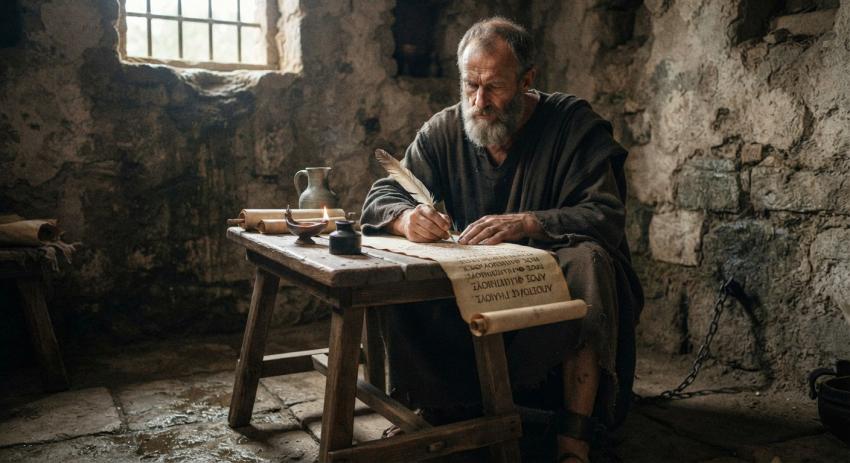
Even the Apostle Paul "used" his Roman citizenship. Whatever anybody thinks or says, the United States of America was founded on a principle as defined in the Declaration of Independence and enforced in the Constitution, that all men (mankind) are equal and endowed with unalienable rights by the Creator. Other religions, other cultures may claim these values but they are absolutely Christian values. Our borders mark the boundary of where those values apply. Outside that boundary other principles... moreEven the Apostle Paul "used" his Roman citizenship. Whatever anybody thinks or says, the United States of America was founded on a principle as defined in the Declaration of Independence and enforced in the Constitution, that all men (mankind) are equal and endowed with unalienable rights by the Creator. Other religions, other cultures may claim these values but they are absolutely Christian values. Our borders mark the boundary of where those values apply. Outside that boundary other principles, other rules can be imposed, but it is a Christian thing to defend these Christian values and the people who live under them.
GML Marc Blaydoe, Grand Marshal
Priory of the Holy Trinity
Dieu Avec Nous!
Life often arrives with an unyielding momentum, sweeping us into unexpected storms of caregiving, professional burnout, or sudden grief that push our spiritual routines to the margins. In those moments when the sheer weight of daily survival feels overwhelming, our instinct can be to isolate or rely solely on our own finite strength. Yet, Scripture gently redirects our gaze away from the chaos and toward the eternal refuge found in God. As Psalm 46:1 reminds us, "God is our refuge and strength, ... moreLife often arrives with an unyielding momentum, sweeping us into unexpected storms of caregiving, professional burnout, or sudden grief that push our spiritual routines to the margins. In those moments when the sheer weight of daily survival feels overwhelming, our instinct can be to isolate or rely solely on our own finite strength. Yet, Scripture gently redirects our gaze away from the chaos and toward the eternal refuge found in God. As Psalm 46:1 reminds us, "God is our refuge and strength, an ever-present help in trouble." This divine availability does not depend on our performance or the cleanliness of our schedules; rather, His grace meets us precisely in the messy, interrupted middle of our days.
Turning to the Lord amid life's distractions requires a conscious shift from frantic striving to quiet trust, echoing the familiar invitation of Matthew 11:28, "Come to me, all you who are weary and burdened, and I will give you rest." When our minds are fragmented by a thousand pressing demands, prayer ceases to be just another item on a to-do list and becomes a lifeline. It is an intentional pause where we release our tight grip on control and acknowledge that we were never meant to carry the weight of the world on our shoulders. This sacred exchange transforms our anxieties into conversations with a Father who knows every detail of our exhaustion and offers peace that surpasses human understanding.
Ultimately, navigating the disruptions of life with faith means learning to see detours not as interruptions to God's work, but as the very soil where His sustaining power is perfected in our weakness. The Apostle Paul captures this truth in 2 Corinthians 12:9, recording the Lord's promise: "My grace is sufficient for you, for my power is made perfect in weakness." When our plans derail and life gets in the way, we are invited to lean into that divine sufficiency. Each unexpected hurdle becomes an opportunity to practice dependence, anchoring our souls to an unchanging anchor so that we emerge from the turbulence deeply rooted, resilient, and renewed by His steady presence.
Scripture establishes a clear theological distinction between human judgment and divine discernment, contrasting the moral presumption of judging others with the spiritual grace required to perceive God's will. Biblical texts repeatedly warn against the dangers of self-righteous condemnation, grounding the prohibition of judgment in God's exclusive authority as ultimate lawgiver. In the Gospel of Matthew, Jesus explicitly commands, "Stop judging, that you may not be judged" (Matthew 7:1), emphas... moreScripture establishes a clear theological distinction between human judgment and divine discernment, contrasting the moral presumption of judging others with the spiritual grace required to perceive God's will. Biblical texts repeatedly warn against the dangers of self-righteous condemnation, grounding the prohibition of judgment in God's exclusive authority as ultimate lawgiver. In the Gospel of Matthew, Jesus explicitly commands, "Stop judging, that you may not be judged" (Matthew 7:1), emphasizing that human beings lack the omniscience required to evaluate the hearts and motives of their peers. Saint Paul reinforces this theological boundary in his Letter to the Romans, asking rhetorically, "Who are you to pass judgment on the servant of another?" and declaring that every individual ultimately stands or falls before God alone (Romans 14:4). These passages delineate human judgment as a usurpation of divine prerogative, warning believers away from punitive evaluation, hypocrisy, and the uncharitable compartmentalization of their neighbors.
Conversely, scripture elevates discernment (diakrisis) as an essential spiritual virtue that empowers believers to navigate moral complexities and align their lives with divine truth. Unlike prohibitive judgment, discernment is framed as a gift of wisdom and spiritual maturity cultivated through prayer, scripture, and the indwelling of the Holy Spirit. The Letter to the Hebrews praises mature believers whose faculties are trained "by practice to distinguish good from evil" (Hebrews 5:14), highlighting discernment as an active, continuous capacity for moral clarity rather than a static condemnation of persons. Similarly, Saint Paul exhorts the Christian community in Philippi to ensure that their "love may abound more and more in knowledge and all discernment," enabling them to evaluate competing choices and "choose what is best" (Philippians 1:9-10).
Christian theology therefore synthesizes these complementary mandates: believers reject the arrogant finality of human judgment while eagerly embracing the discerning wisdom necessary to live righteously within a complex world.
Thought you'd all find this interesting; I participated in a Bible Study this week that attempted to define Jesus utilizing modern political orientations. Reminding my group members that THIS is largely a futile exercise, I made the following argument just for arguments sake...Enjoy, and Deus Vult!
The argument that Jesus was a libertarian rests on his consistent defense of individual liberty, voluntary charity, and strict limitations on political power. Christian libertarians argue that while ... moreThought you'd all find this interesting; I participated in a Bible Study this week that attempted to define Jesus utilizing modern political orientations. Reminding my group members that THIS is largely a futile exercise, I made the following argument just for arguments sake...Enjoy, and Deus Vult!
The argument that Jesus was a libertarian rests on his consistent defense of individual liberty, voluntary charity, and strict limitations on political power. Christian libertarians argue that while Jesus held humanity to an incredibly high moral standard, he always advocated for these choices to be made through free will rather than state-enforced coercion. By analyzing his actions and teachings, proponents of this view argue that his message aligns cleanly with the modern libertarian emphasis on private property, the non-aggression principle, and deep skepticism toward centralized government authorities.First, libertarians emphasize that Jesus viewed charity as a purely voluntary virtue rather than a mandate for state redistribution. In the Parable of the Workers in the Vineyard (Matthew 20:15), a landowner asserts his economic autonomy, asking, "Don’t I have the right to do what I want with my own money?"
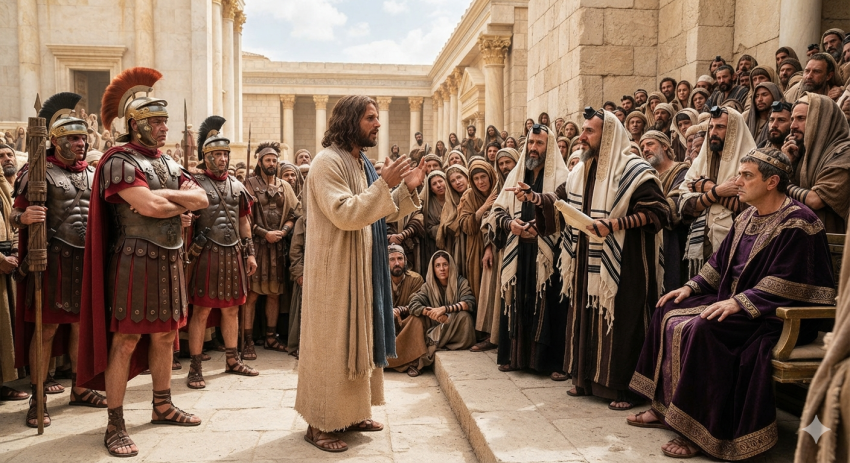
Furthermore, when Jesus challenges the Rich Young Ruler in Matthew 19:21 to "go, sell your possessions and give to the poor," he issues a personal, moral invitation to the individual's conscience. He notably never appeals to the Roman Empire or local tax authorities to confiscate wealth by force to achieve economic equity.Second, Jesus established clear boundaries between secular governance and personal liberty, which libertarians interpret as a severe restriction on state authority. When questioned about paying taxes in Matthew 22:21, he famously replied, "So give back to Caesar what is Caesar’s, and to God what is God’s." Rather than endorsing total government control, this division implies that Caesar’s legitimate jurisdiction is heavily constrained. Because an individual's soul, mind, and labor ultimately belong to God, they remain entirely outside the rightful ownership or regulation of the state.Third, Jesus demonstrated a profound skepticism toward political power and rejected top-down, authoritarian rule. In Matthew 20:25-26, he directly warns his disciples against replicating the coercive structures of secular governments, stating, "You know that the rulers of the Gentiles lord it over them... Not so with you. Instead, whoever wants to become great among you must be your servant." He actively resisted political institutions, even fleeing to a mountain in John 6:15 when a crowd "intended to come and make him king by force." He later affirmed to Pontius Pilate in John 18:36 that his kingdom was not of this world, precisely because it did not rely on military or state enforcement.
Finally, Jesus’s teachings strongly mirror the libertarian Non-Aggression Principle (NAP), which forbids the initiation of force against others. When his disciple Peter draws a weapon to violently resist arrest in Gethsemane, Jesus forcefully rebukes him in Matthew 26:52, commanding, "Put your sword back in its place, for all who draw the sword will die by the sword." By rejecting institutional violence and coercive political systems, Jesus championed a framework where social cooperation must be entirely peaceful and consensual. Together, these scriptural arguments form the basis for viewing Jesus as a teacher who prioritized individual liberty over the power of the state.
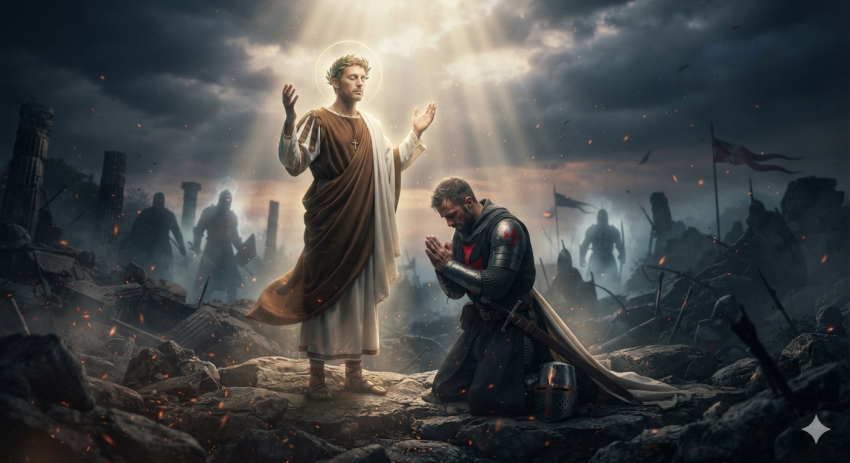
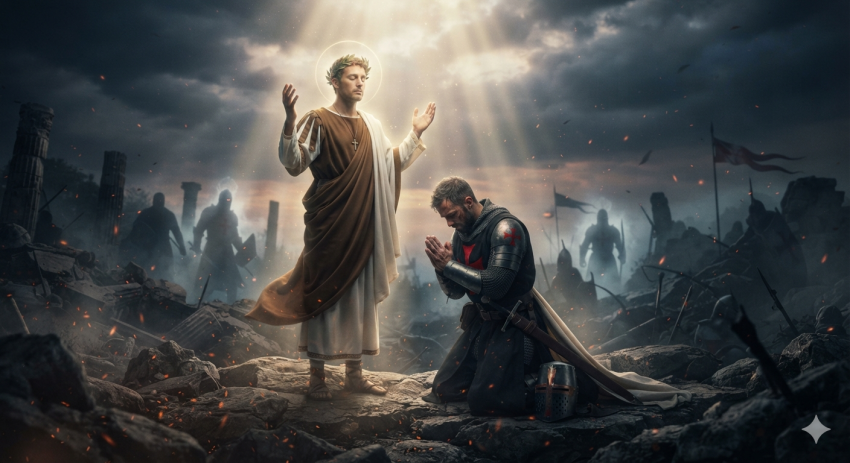
August 11th is the Feast of Saint Tiburtius; Saint Tiburtius serves as a powerful blueprint for spiritual warfare, fraternity, and moral courage within contemporary chivalric frameworks. His defiance of Diocletian's secular laws to secretly bury martyred Christians directly mirrors the original Templar duty of honoring the fallen and defending the vulnerable against societal pressures. For a modern knight, Tiburtius’s dangerous works of mercy emphasize that true chivalry requires standing firm i... moreAugust 11th is the Feast of Saint Tiburtius; Saint Tiburtius serves as a powerful blueprint for spiritual warfare, fraternity, and moral courage within contemporary chivalric frameworks. His defiance of Diocletian's secular laws to secretly bury martyred Christians directly mirrors the original Templar duty of honoring the fallen and defending the vulnerable against societal pressures. For a modern knight, Tiburtius’s dangerous works of mercy emphasize that true chivalry requires standing firm in Christian ethics, even when those values clash with dominant cultural norms.
Furthermore, Tiburtius’s story highlights the essential Templar principle of absolute brotherhood and converting the adversary through personal integrity. By facing his execution alongside his brother Valerian, he exemplifies how fraternal unity strengthens spiritual resolve. His unwavering composure while walking over red-hot coals ultimately converted his guard, Maximus, proving to a 2026 Templar that discipline, calm endurance, and action-oriented faith are far more potent tools for defending the Church than aggressive confrontation.
August 11th is the Feast of Saint Tiburtius; Saint Tiburtius serves as a powerful blueprint for spiritual warfare, fraternity, and moral courage within contemporary chivalric frameworks. His defiance of Diocletian's secular laws to secretly bury martyred Christians directly mirrors the original Templar duty of honoring the fallen and defending the vulnerable against societal pressures. For a modern knight, Tiburtius’s dangerous works of mercy emphasize that true chivalry requires standing firm i... moreAugust 11th is the Feast of Saint Tiburtius; Saint Tiburtius serves as a powerful blueprint for spiritual warfare, fraternity, and moral courage within contemporary chivalric frameworks. His defiance of Diocletian's secular laws to secretly bury martyred Christians directly mirrors the original Templar duty of honoring the fallen and defending the vulnerable against societal pressures. For a modern knight, Tiburtius’s dangerous works of mercy emphasize that true chivalry requires standing firm in Christian ethics, even when those values clash with dominant cultural norms.
Furthermore, Tiburtius’s story highlights the essential Templar principle of absolute brotherhood and converting the adversary through personal integrity. By facing his execution alongside his brother Valerian, he exemplifies how fraternal unity strengthens spiritual resolve. His unwavering composure while walking over red-hot coals ultimately converted his guard, Maximus, proving to a 2026 Templar that discipline, calm endurance, and action-oriented faith are far more potent tools for defending the Church than aggressive confrontation.