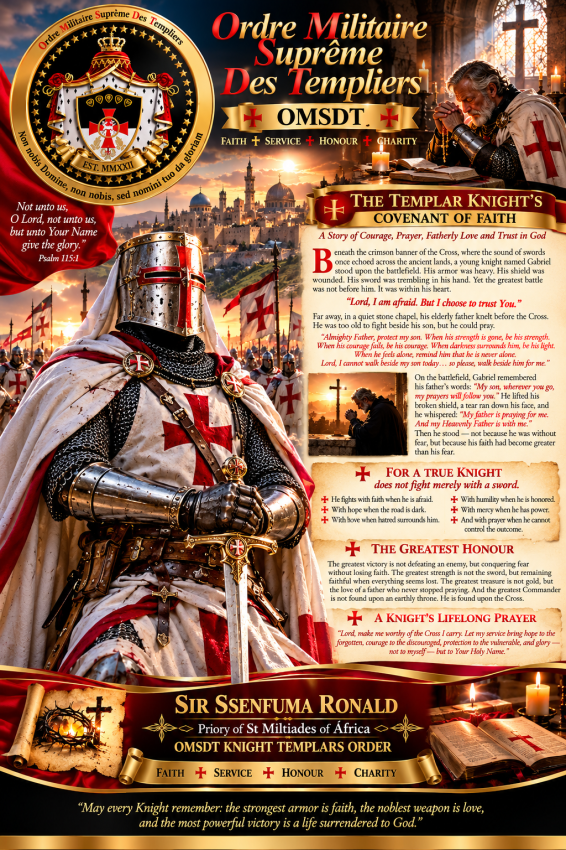
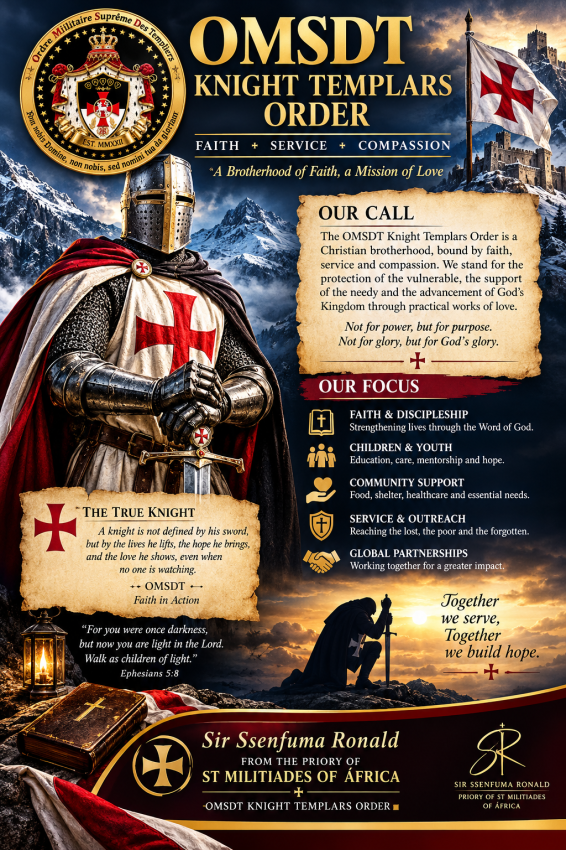
⚔️ THE TEMPLAR KNIGHT’S COVENANT OF FAITH ⚔️
A Story of Courage, Prayer, Fatherly Love and Trust in God
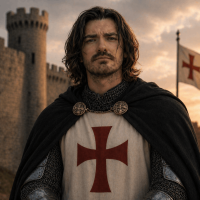
Beneath the crimson banner of the Cross, where the sound of swords once echoed across the ancient lands, a young knight named Gabriel stood upon the battlefield.
His armor was heavy.
His shield was wounded.
His sword was trembling in his hand.
Yet the greatest battle was not before him.
It was within his heart.
He looked toward the heavens and whispered:
“Lord, I am afraid. But I choo... more⚔️ THE TEMPLAR KNIGHT’S COVENANT OF FAITH ⚔️
A Story of Courage, Prayer, Fatherly Love and Trust in God
Beneath the crimson banner of the Cross, where the sound of swords once echoed across the ancient lands, a young knight named Gabriel stood upon the battlefield.
His armor was heavy.
His shield was wounded.
His sword was trembling in his hand.
Yet the greatest battle was not before him.
It was within his heart.
He looked toward the heavens and whispered:
“Lord, I am afraid. But I choose to trust You.”
Far away, in a quiet stone chapel, his elderly father knelt before the Cross.
He was too old to fight beside his son.
He could not carry Gabriel's shield.
He could not stand between him and danger.
But there was one thing he could do.
He could pray.
With tears flowing down his face, the father lifted his hands toward heaven.
“Almighty Father, protect my son.
When his strength is gone, be his strength.
When his courage fails, be his courage.
When darkness surrounds him, be his light.
When he feels alone, remind him that he is never alone.”
His voice broke.
“Lord, I cannot walk beside my son today…
so please, walk beside him for me.”
On the battlefield, Gabriel suddenly felt a strange peace.
The arrows continued to fly.
The horses continued to thunder.
The swords continued to clash.
But within his heart, he remembered his father's final words:
“My son, wherever you go, my prayers will follow you.”
Gabriel lifted his broken shield.
A tear ran down his face.
And he whispered:
“My father is praying for me.”
He looked toward the Cross upon his breast.
“And my Heavenly Father is with me.”
Then he stood.
Not because he was without fear.
But because his faith had become greater than his fear.
He moved forward not seeking glory, riches or recognition, but determined to protect the weak, defend the innocent, serve with humility, and remain faithful to God.
For a true Knight does not fight merely with a sword.
He fights with faith when he is afraid.
With hope when the road is dark.
With love when hatred surrounds him.
With humility when he is honored.
With mercy when he has power.
And with prayer when he cannot control the outcome.
✠ THE GREATEST HONOUR
Years later, Gabriel would understand what his father had tried to teach him.
The greatest victory was not defeating an enemy.
It was conquering fear without losing faith.
The greatest strength was not the strength of the sword.
It was the strength to remain faithful when everything seemed lost.
The greatest treasure was not gold.
It was the love of a father who never stopped praying.
And the greatest Commander was not found upon an earthly throne.
He was found upon the Cross.
So Gabriel carried one prayer throughout the rest of his life:
“Lord, make me worthy of the Cross I carry.
Let my service bring hope to the forgotten,
courage to the discouraged,
protection to the vulnerable,
and glory—not to myself—but to Your Holy Name.”
**“Not unto us, O Lord, not unto us,
but unto Your Name give the glory.”**
Psalm 115:1
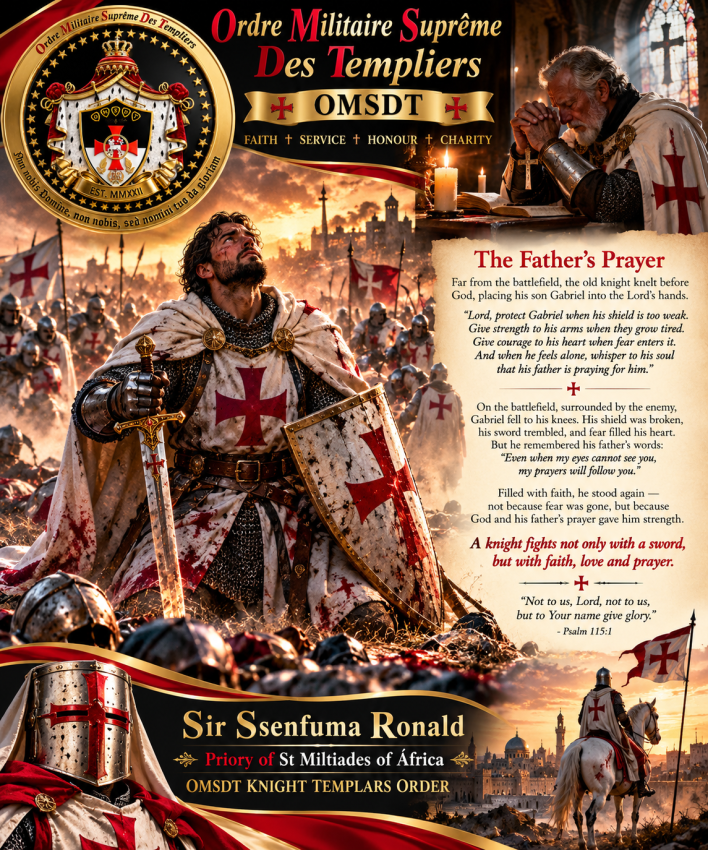
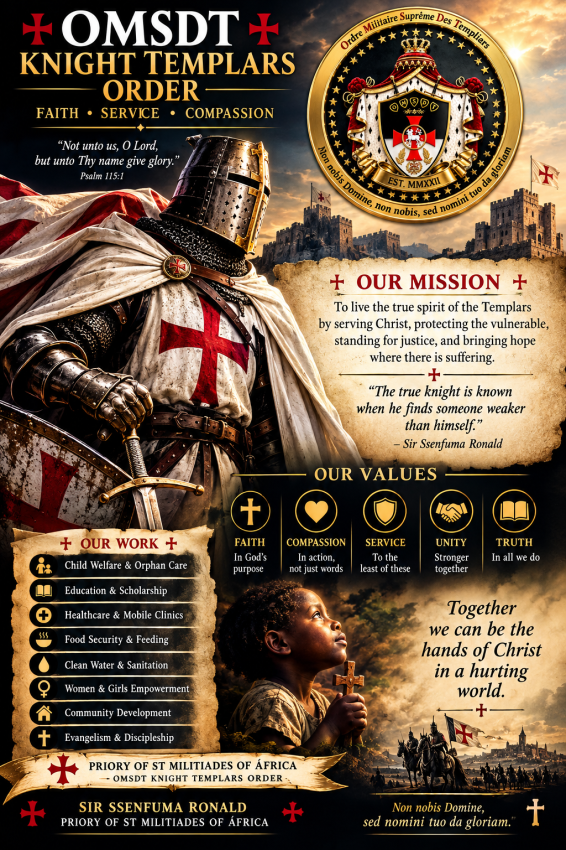
⚔️ SIR SSENFUMA RONALD
Priory of St Miltiades of África
OMSDT KNIGHT TEMPLARS ORDER
FAITH • SERVICE • HONOUR • CHARITY
May every Knight remember: the strongest armor is faith, the noblest weapon is love, and the most powerful victory is a life surrendered to God.
The Father’s Prayer
Far from the battlefield, in the small stone chapel where he had prayed every morning since Gabriel was a child, the old knight knelt before a wooden cross.
He had tried to remain calm.
He had told himself that his son was trained, that Gabriel was surrounded by brave men, that he had placed his life in God's hands.
But a father's heart does not understand distance.
The old man's hands trembled.
He bowed his head.
“Father in Heaven…”
His voice broke.
“Today I place m... moreThe Father’s Prayer
Far from the battlefield, in the small stone chapel where he had prayed every morning since Gabriel was a child, the old knight knelt before a wooden cross.
He had tried to remain calm.
He had told himself that his son was trained, that Gabriel was surrounded by brave men, that he had placed his life in God's hands.
But a father's heart does not understand distance.
The old man's hands trembled.
He bowed his head.
“Father in Heaven…”
His voice broke.
“Today I place my son into Your hands.”
A tear fell onto the stone floor.
“Lord, You gave him to me, and I have loved him since the first moment I held him. I taught him to walk. I taught him to hold a sword. I taught him to stand when life knocked him down.”
He paused, struggling to breathe.
“But today, Lord, I cannot stand beside him.”
His fingers tightened around the small wooden cross hanging from his neck.
“So You must stand beside him for me.”
Outside the chapel, the distant sound of war could barely be heard across the valley.
The father closed his eyes.
“Protect Gabriel when his shield is too weak. Give strength to his arms when they grow tired. Give courage to his heart when fear enters it.”
His voice became softer.
“And when he believes he is alone…”
The old father swallowed his tears.
“Whisper to his soul that his father is praying for him.”
At that very moment, on the battlefield, Gabriel fell to his knees.
His shield had cracked.
His sword trembled in his hand.
The enemy surrounded him.
Gabriel looked toward the sky.
“Lord,” he whispered, “I am afraid.”
And thousands of footsteps thundered around him.
In the chapel, his father continued:
“Lord, if he must face pain, give him endurance. If he must face fear, give him faith. If he must face darkness, remind him that Your light cannot be overcome by it.”
The old knight's shoulders shook.
“Please, Lord…”
He lowered his head until his forehead touched the cold stone.
“Bring my boy home.”
On the battlefield, Gabriel suddenly remembered his father's embrace.
He remembered the words spoken to him before he left:
“Even when my eyes cannot see you, my prayers will follow you.”
Gabriel's eyes filled with tears.
He lifted his broken shield.
Then, through the chaos, he whispered:
“My father is praying for me.”
Something changed within him.
The fear did not disappear.
But he no longer felt alone.
He stood.
“God is with me.”
He raised his sword.
“My father is praying for me.”
And he stepped forward.
Back in the chapel, the old father suddenly lifted his head.
He did not know why, but peace had entered his heart.
He whispered one final prayer:
“Lord, whatever happens today, let my son never forget that he is loved. Let him know that his worth is not measured by victory, strength, or the battles he wins. Let him know that he is Your child before he is ever a knight.”
A long silence followed.
Then the old man smiled through his tears.
“Amen.”
Far away, beneath a sky darkened by smoke, Gabriel stood among the surviving Templars.
He looked toward the horizon.
And though he could not see his father's face, he felt the love of his father's prayer surrounding his heart.
He raised his sword toward the heavens.
“Thank You, Lord.”
And for the first time that day, Gabriel was no longer fighting simply to survive.
He was fighting to return home to the father who had never stopped believing in him.
And somewhere in the quiet chapel, an old father continued to pray.
✠ A TRIBUTE OF GRATITUDE & HOPE ✠
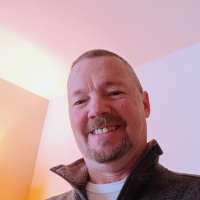
To the OMSDT Knight Templars Order, Grand Prior Brother Derek Nordio, our beloved Ambassador Brother Sir Joseph DePiero, and Mummy Janice Blakeley,
Today, the Ronsen Hope family pauses with humble and joyful hearts to say THANK YOU.
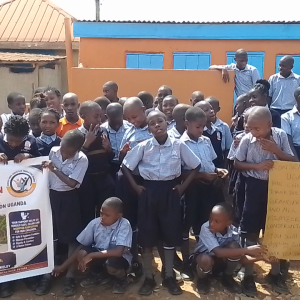
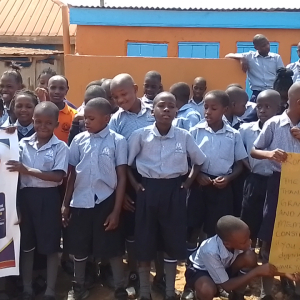
The reconstruction of our children’s school toilets has reached a major milestone, and behind this progress are people who chose to stand with vulnerable children when their need was greatest.
Your support has become more than br... more✠ A TRIBUTE OF GRATITUDE & HOPE ✠
To the OMSDT Knight Templars Order, Grand Prior Brother Derek Nordio, our beloved Ambassador Brother Sir Joseph DePiero, and Mummy Janice Blakeley,
Today, the Ronsen Hope family pauses with humble and joyful hearts to say THANK YOU.
The reconstruction of our children’s school toilets has reached a major milestone, and behind this progress are people who chose to stand with vulnerable children when their need was greatest.
Your support has become more than bricks, cement, doors, and walls. It has become dignity for a child, safety for a student, comfort for a family, and a visible reminder that compassion still builds bridges between hearts across nations.
To our Templar family and our dear Ambassadors, we are deeply grateful that you believed in this mission and walked beside us. Your example reminds us that when people unite in service, even a difficult beginning can become a beautiful testimony of hope.
The children may not know every name behind this work, but one day they will know that people they had never met cared enough to help make their world better.
“When love becomes action, a simple gift can leave footprints of hope in the lives of generations.”
May God bless the OMSDT Knight Templars Order, Grand Prior Derek, Sir Joseph, Mummy Janice, and every person whose heart has been touched by the Ronsen Hope mission.
✠ Non Nobis, Domine Not for ourselves, O Lord, but for those entrusted to our care. ✠
With profound gratitude,
Ssenfuma Ronald
Director & Chairman
Ronsen Hope Christian Foundation Uganda
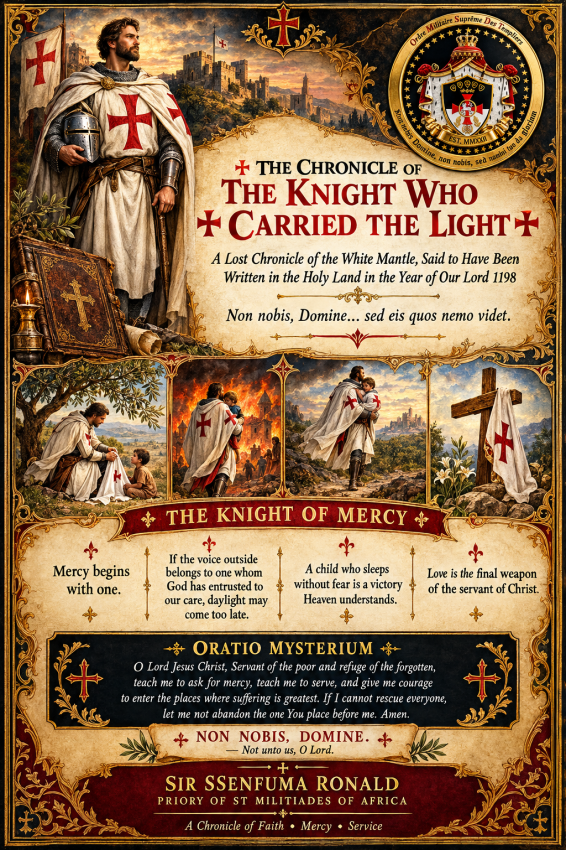
✠ THE CHRONICLE OF THE KNIGHT WHO CARRIED THE LIGHT ✠
A Lost Chronicle of the White Mantle, Said to Have Been Written in the Holy Land in the Year of Our Lord 1198
«“Non nobis, Domine… sed eis quos nemo videt.”
Not for ourselves, O Lord… but for those whom no one sees.»
✠ PROLOGUS ✠
Of the Manuscript That Was Hidden Beneath the Altar
In the year of Our Lord 1887, when the stones of an abandoned monastery were being cleared after an earthquake, the brothers discovered something beneath the ... more✠ THE CHRONICLE OF THE KNIGHT WHO CARRIED THE LIGHT ✠
A Lost Chronicle of the White Mantle, Said to Have Been Written in the Holy Land in the Year of Our Lord 1198
«“Non nobis, Domine… sed eis quos nemo videt.”
Not for ourselves, O Lord… but for those whom no one sees.»
✠ PROLOGUS ✠
Of the Manuscript That Was Hidden Beneath the Altar
In the year of Our Lord 1887, when the stones of an abandoned monastery were being cleared after an earthquake, the brothers discovered something beneath the broken altar.
It was not gold.
It was not a relic.
It was not the sword of a king.
It was an iron-bound chest.
Inside lay seventeen sheets of ancient vellum, tied together with a cord that had long ago turned the colour of blood.
The first pages were missing.
The final pages were burned.
But upon the first surviving leaf were these words:
«“I write this not that men may remember the knight, but that they may remember the forgotten.”»
The manuscript bore no royal seal.
No great name.
Only a simple mark:
✠ A WHITE MANTLE OVER A BROKEN HEART ✠
And beneath it:
“The Chronicle of Gabriel, Knight of Mercy.”
What follows is the portion that survived.
✠ CAPUT PRIMUM ✠
The Night When the Lord Sent a Cry Through the Darkness
It was a night without moonlight.
The desert wind moved like a spirit through the hills.
Within the fortress, the brothers slept.
The lamps had nearly died.
The guards upon the eastern wall stood beneath a sky filled with stars.
Then, at the third hour before dawn, the youngest sentry heard something.
At first he thought it was the wind.
Then he heard it again.
A cry.
Small.
Broken.
Human.
He called to the captain.
“Someone is outside.”
The captain listened.
Nothing.
Then came the cry again:
“Please…”
The captain ordered the gate to remain closed.
“It may be a trap.”
But among the knights stood one man who had heard enough.
Sir Gabriel of Acre.
He took his lantern.
The captain stopped him.
“Gabriel, wait for daylight.”
Gabriel looked toward the darkness.
Then he answered:
«“If the voice outside belongs to one whom God has entrusted to our care, daylight may come too late.”»
And he walked into the night.
✠ CAPUT SECUNDUM ✠
The Little One Who Had No Name
Beneath a dead olive tree he found her.
A little girl.
Perhaps six years old.
Her dress was torn.
Her feet were bleeding.
She was holding a small wooden cross.
Gabriel lowered his lantern.
“Child…”
She did not answer.
“Where is your mother?”
Silence.
“Where is your father?”
The child looked at the ground.
Then she whispered:
“They went to Heaven.”
Gabriel closed his eyes.
For a moment, the warrior disappeared.
Only the man remained.
He removed his white mantle.
He wrapped it around the child.
Then he lifted her into his arms.
She was so light that Gabriel wondered how someone so small could carry so much sorrow.
As he walked toward the fortress, she whispered:
“Are you going to leave me too?”
Gabriel stopped.
The lantern trembled in his hand.
He knelt.
He looked directly into her eyes.
And said:
«“No, little one. Tonight you have been found.”»
✠ CAPUT TERTIUM ✠
The Promise
When they reached the fortress, Gabriel carried the child to the fire.
The brothers brought bread.
She would not eat.
They brought milk.
She turned away.
Gabriel sat beside her.
Hours passed.
Finally, she took his hand.
“Sir Knight…”
“Yes?”
“Does God know where I am?”
Gabriel's eyes filled with tears.
He answered:
«“Before I knew your name, God knew your name.”»
The child looked at him.
“Then why did He let me become alone?”
Gabriel had no easy answer.
So he did not give her one.
He simply held her.
And after a long silence, he said:
«“I do not know why suffering came to you.
But I know this: you will not face it alone.”»
That was the promise.
And Gabriel kept it.
✠ CAPUT QUARTUM ✠
The Secret of the White Mantle
Years later, an old brother asked Gabriel:
“Why do you care so greatly for the poor?”
Gabriel looked at his white mantle.
He said:
«“Because I once believed that a knight's greatness was measured by the enemies he defeated.”»
The old brother waited.
Gabriel continued:
«“Then I met a child who had no army, no wealth, no weapon, and no one to defend her.”»
He smiled.
«“And she taught me that courage is not always found where swords are drawn.”»
Then he placed his hand upon the mantle.
«“The white cloth means nothing if the heart beneath it is dark.”»
✠ CAPUT QUINTUM ✠
The Day the Village Burned
It happened in the summer of the great war.
Smoke rose beyond the eastern hills.
The village was burning.
The knights gathered upon the walls.
The commander gave the order:
“No one leaves the fortress.”
Then came the cries.
Women.
Children.
The elderly.
The wounded.
Gabriel stood upon the wall.
One young knight said:
“Brother, there are too many.”
Gabriel looked down.
Then he answered:
«“There was once only one.”»
The young knight did not understand.
Gabriel looked toward the burning village.
«“When I found her, I could have said she was only one child.”»
He drew his sword.
«“Mercy always begins with one.”»
And the gate opened.
✠ CAPUT SEXTUM ✠
The Ride Into the Fire
The knights rode into the village.
They carried children from burning houses.
They lifted the wounded.
They broke open locked doors.
They led the blind through smoke.
Gabriel entered the final house.
Inside he found an old woman unable to walk.
He lifted her onto his horse.
Then he heard crying.
A child was trapped beneath a fallen beam.
Gabriel returned.
The flames were spreading.
“Leave him!” shouted a knight.
“The roof will collapse!”
Gabriel did not answer.
He threw aside his shield.
He lifted the beam.
The child crawled free.
Gabriel pushed him toward the waiting knight.
Then the roof came down.
The young knight shouted:
“GABRIEL!”
Smoke swallowed him.
For several terrible moments, there was silence.
Then, through the flames, a white figure emerged.
Gabriel was still standing.
His armour was broken.
His face was bleeding.
But in his arms was another child.
✠ CAPUT SEPTIMUM ✠
The Last Gate
They reached the fortress before dawn.
Hundreds had been saved.
The gates began to close.
Then Gabriel heard something.
A voice.
Far behind them.
A child.
He turned.
The enemy was approaching.
The gates were almost shut.
The captain shouted:
“Gabriel! Come inside!”
Gabriel looked at the people behind the gates.
Then toward the darkness.
He heard the child again.
“Help me!”
Gabriel knew what he must do.
The young knight seized his arm.
“You cannot go back!”
Gabriel looked at him.
And said quietly:
«“Then who will?”»
He turned his horse.
And rode back.
✠ CAPUT OCTAVUM ✠
The Last Light
The child was found beneath a fallen cart.
Gabriel freed him.
But as he lifted the child, an arrow struck him.
He fell.
The child began to cry.
Gabriel forced himself to stand.
“Do not be afraid.”
“You are hurt!”
“Yes.”
“Will you die?”
Gabriel looked toward the distant fortress.
Then toward the rising dawn.
He smiled.
«“Every knight dies one day.”»
He placed the child upon his horse.
“But today, you will live.”
The horse carried the child toward the fortress.
Gabriel remained behind.
The young knight returned with the others.
They found him beneath the first light of morning.
His sword lay beside him.
His white mantle was covered with dust and blood.
But his face was peaceful.
In his hand was the little wooden cross.
The same cross that had once belonged to the first child he saved.
✠ CAPUT NOVISSIMUM ✠
What the Brothers Found Upon His Heart
When they lifted Gabriel's mantle, they found a piece of parchment sewn inside his armour.
Upon it were written only these words:
“If ever you wonder whether your life has mattered, look not at what you possessed.”
“Look at who was safer because you lived.”
Beneath that was another sentence:
“A child who sleeps without fear is a victory Heaven understands.”
And beneath it:
“Love is the final weapon of the servant of Christ.”
The brothers buried Gabriel without trumpets.
Without gold.
Without a monument.
They placed his broken sword upon the grave.
But his white mantle was not buried.
It was given to the child he had saved.
✠ THE CHILD'S TESTIMONY ✠
Many years passed.
The child became a man.
He never forgot Gabriel.
He became a protector of orphans.
He built shelters.
He fed the hungry.
He cared for widows.
And whenever people praised him, he would answer:
“Do not praise me.”
“Why?”
«“I am only continuing what another man began.”»
“What did he begin?”
The man would smile.
And say:
«“He taught one frightened child that being forgotten by men does not mean being forgotten by God.”»
✠ ORATIO MYSTERIUM ✠
The Prayer of the Knight of the White Mantle
O Lord Jesus Christ,
Servant of the poor and refuge of the forgotten,
Before I ask You for victory,
teach me to ask for mercy.
Before I ask You for honour,
teach me to serve.
Before I ask You for strength,
show me who needs my strength.
Give me eyes that notice the child standing alone.
Give me ears that hear the cry hidden beneath the noise of the world.
Give me hands that build where others have destroyed.
Give me courage to enter the places where suffering is greatest.
And when I have little,
teach me not to say,
“I have nothing to give.”
For perhaps I still have a hand to hold.
Perhaps I still have a prayer to pray.
Perhaps I still have a little bread to share.
Perhaps I still have a heart capable of loving.
Lord, make my life useful to those who have no voice.
If I cannot rescue everyone,
let me not abandon the one You place before me.
If I cannot change the whole world,
let me change the small world of one suffering soul.
And when my journey is finished,
do not let Heaven remember the things I collected.
Let Heaven remember the people I served.
Let the hungry remember that I fed them.
Let the lonely remember that I stayed.
Let the wounded remember that I knelt.
Let the child remember that I came.
And if one frightened soul can someday say,
“Because someone loved me, I learned that God had not forgotten me,”
then let that be my crown.
Let that be my victory.
Let that be my legacy.
Amen.
✠ THE FINAL LEAF ✠
The final leaf of the manuscript was almost entirely destroyed.
Only a few words survived.
They were written in red ink.
Perhaps they were the final words of Brother Matthieu.
Perhaps they were written by another hand.
No one knows.
But they read:
«“When the last sword has rusted…”
“When the last castle has fallen…”
“When the names of kings have disappeared from the memory of men…”
“There will remain one thing that Heaven will never forget.”»
The final word was written alone.
MERCY.
And beneath it, the ancient sign:
✠
NON NOBIS, DOMINE.
Not unto us, O Lord.
✠ THE CHRONICLE OF THE WHITE MANTLE ✠
A Lost Chronicle Said to Have Been Written in the Holy Land, in the Year of Our Lord 1197
«“Non gladius facit militem, sed misericordia.”
It is not the sword that makes the knight, but mercy.»
---
PROLOGUS
Here Begins the Account of a Deed Which Men Forgot
In the Name of the Father, and of the Son, and of the Holy Spirit.
I, Brother Matthieu, servant of the poor and unworthy keeper of the records of our house, write these things lest they perish from... more✠ THE CHRONICLE OF THE WHITE MANTLE ✠
A Lost Chronicle Said to Have Been Written in the Holy Land, in the Year of Our Lord 1197
«“Non gladius facit militem, sed misericordia.”
It is not the sword that makes the knight, but mercy.»
---
PROLOGUS
Here Begins the Account of a Deed Which Men Forgot
In the Name of the Father, and of the Son, and of the Holy Spirit.
I, Brother Matthieu, servant of the poor and unworthy keeper of the records of our house, write these things lest they perish from the memory of men.
Many chronicles speak of victories.
Many record the names of kings.
Many praise those who conquered cities and returned carrying banners.
But I have learned that Heaven keeps another kind of record.
For the Lord remembers the cup of water given to the thirsty.
He remembers the bread divided when there was little.
He remembers the hand stretched toward the fallen.
And He remembers the knight who turned his horse away from glory because he heard the cry of a child.
Therefore I write of Sir Gabriel of Acre.
Not because he was the greatest knight among us.
But because, when tested, he chose mercy.
And this is the account.
---
✠ CAPUT PRIMUM ✠
Of the Bell That Rang Before Dawn
In the seventh year of the great drought, when the wells of the villages had become bitter and the earth was cracked like old parchment, our fortress stood beneath the pale moon.
The brothers had completed their prayers.
The fires were dying.
The sentries stood upon the walls.
Then, shortly before dawn, the bell sounded.
Once.
Then twice.
Then a third time.
The captain of the watch cried:
“Who goes there?”
No answer came.
Again:
“Who goes there?”
From beyond the gate came only the sound of weeping.
The knights took up their swords.
But Sir Gabriel did not draw his.
He took a lantern.
The captain seized his arm.
“Brother, wait for the guards.”
Gabriel answered:
«“If the voice outside belongs to one who is dying, every moment we wait is another moment they suffer.”»
And he opened the gate.
---
✠ CAPUT SECUNDUM ✠
Of the Child Beneath the Dead Tree
There, beside a dead olive tree, lay a child.
She was perhaps seven winters old.
Her feet were wounded.
Her lips were dry.
Around her neck hung a small wooden cross.
She clutched it with both hands.
Gabriel knelt.
“Child, where is your father?”
No answer.
“Where is your mother?”
The child looked toward the eastern road.
“She told me to wait.”
“For whom?”
“For God.”
At these words, Gabriel lowered his head.
For he understood that the child had waited so long that she had ceased expecting men to return.
He removed his white mantle.
He wrapped it around her.
Then he lifted her into his arms.
The captain asked:
“Sir Gabriel, what shall we do with her?”
Gabriel looked upon the child.
And said:
«“First, we shall make her safe.
Afterwards, we shall ask what must be done.”»
---
✠ CAPUT TERTIUM ✠
The Knight Who Would Not Eat
The child was brought into the fortress.
Bread was placed before her.
She would not eat.
Water was offered.
She drank only a little.
Gabriel sat beside her through the night.
At the third hour, the steward brought him his supper.
The knight pushed the plate away.
“Why do you not eat?” asked the steward.
Gabriel pointed toward the child.
“She has not eaten.”
“There is enough for you both.”
Gabriel shook his head.
“Then divide it.”
The steward divided the bread.
Half for Gabriel.
Half for the child.
But Gabriel quietly broke his half again and placed it beside hers.
The steward protested.
“Brother, you need strength.”
Gabriel answered:
«“Then let my strength begin with giving.”»
And the steward wept.
For he had seen many knights fight for bread.
He had rarely seen one surrender his portion without being asked.
---
✠ CAPUT QUARTUM ✠
The Secret Written Beneath the Mantle
Three days later, the child spoke.
Her name was Miriam.
Her village had been attacked by raiders.
Her father had died.
Her mother had carried her into the hills.
But hunger and sickness overcame her.
Before dying, her mother had placed the wooden cross around Miriam's neck.
And said:
«“When you are afraid, remember that Christ sees you.”»
Gabriel never forgot those words.
From that day forward, he made the child his charge.
But some among the brothers questioned him.
“A knight has duties,” they said.
“You cannot carry every orphan.”
“You cannot rescue every widow.”
“You cannot feed every hungry man.”
Gabriel answered:
«“Perhaps not.”»
Then he looked toward the poor gathered outside the gate.
«“But I can refuse to abandon the one standing before me.”»
---
✠ CAPUT QUINTUM ✠
The Night of Fire
On the Feast of Saint Michael, enemies came upon the fortress.
Their torches appeared like a river of fire upon the hills.
The horns sounded.
The gates were barred.
The knights took their positions.
Gabriel stood upon the wall.
Then he heard something beneath the cries of battle.
Children.
The village below was burning.
Women were fleeing.
The elderly were trapped.
The captain shouted:
“Hold the wall!”
Gabriel looked down.
The fortress was secure.
The people outside were not.
He turned to the commander.
“If we remain here, they will die.”
“We cannot abandon the fortress.”
Gabriel answered:
«“Then open the gate.”»
The commander stared at him.
“You would risk everything?”
Gabriel drew his sword.
“No.”
He looked toward the burning village.
«“I would risk myself.”»
---
✠ CAPUT SEXTUM ✠
The Gate of Mercy
The great gate opened.
Gabriel and a small company rode into the darkness.
They found the villagers scattered among the flames.
A woman carried an infant.
An old man crawled through the dust.
Three children hid beneath a broken cart.
Gabriel dismounted.
He carried the old man.
Another knight carried the infant.
The others gathered the children.
Again and again they returned.
But the enemy drew closer.
“Sir Gabriel!” cried one knight.
“We must go!”
Gabriel looked back.
A little boy stood frozen in the road.
His mother was dead beside him.
Gabriel rode toward him.
The enemy was approaching.
The boy could not move.
Gabriel dismounted.
He lifted him.
And placed the child upon his horse.
Then an arrow struck Gabriel beneath the shoulder.
He fell to one knee.
The young knight cried:
“Brother!”
Gabriel rose again.
Blood ran beneath his armour.
He said only:
«“Take the child.”»
---
✠ CAPUT SEPTIMUM ✠
The Last Stand of the White Mantle
The refugees reached the fortress.
But Gabriel remained outside.
The young knight returned.
“Sir Gabriel! Come!”
Gabriel looked at the closing gates.
Behind them were children.
He heard their crying.
He smiled.
“Close the gate.”
“No!”
“Close it.”
“But you will remain outside!”
Gabriel placed his hand upon the young knight's shoulder.
«“A knight's life is not his own when another life depends upon it.”»
The gates began to close.
The young knight wept.
“Brother Gabriel!”
Gabriel stood alone beneath the burning sky.
His white mantle was torn.
His sword was broken.
His blood stained the earth.
Yet he did not retreat.
Not because he hated those who came against him.
But because behind those walls were people who could not defend themselves.
And so the last thing the young knight saw before the gates closed was the white mantle of Gabriel standing beneath the dawn.
---
✠ CAPUT OCTAVUM ✠
What Was Found at Dawn
When morning came, the knights opened the gate.
There was no sign of Gabriel.
Only his broken sword.
His white mantle.
And beneath it, the small wooden cross that Miriam had once carried.
The commander picked it up.
On the inside of the mantle, sewn into the cloth, they discovered words written in faded thread:
“If I am absent, serve the one who remains.”
The brothers knelt.
No trumpet sounded.
No king came.
No herald announced his name.
Only the poor stood outside the gate.
And Miriam, the little girl he had once found beneath the olive tree, placed her hand upon the bloodstained mantle.
She whispered:
“He told me God had not forgotten me.”
Then she looked toward the sky.
“And now I know why.”
✠ CAPUT NOVISSIMUM ✠
The Law of the White Mantle
Before his death, Gabriel had written seven words upon a piece of parchment.
They became known among the brothers as The Law of the White Mantle:
«“Protect the weak. Feed the hungry. Serve Christ.”»
Beneath them he had written:
«“Let no man call himself a knight merely because he carries a sword.
The true knight is known when he finds someone weaker than himself.”»
And beneath that:
“Where the forgotten are found, there must the servant of Christ be.”
✠ ORATIO ULTIMA ✠
The Prayer of the Knight Before the Last Battle
O Lord Jesus Christ,
Who didst humble Thyself for the salvation of mankind,
Strip from me every pride that prevents me from serving.
Give me eyes to see the forgotten,
ears to hear the cry of the helpless,
hands willing to serve,
and a heart that does not turn away.
When I possess much, teach me to share.
When I possess little, teach me gratitude.
When I am strong, teach me gentleness.
When I am afraid, teach me courage.
And if ever I stand before one who is hungry,
let me not speak of tomorrow.
Let me give him bread today.
If I find a child without shelter,
let me not merely pray for shelter.
Let my hands become the shelter.
If I find the wounded,
let me kneel.
If I find the abandoned,
let me remain.
And when my final hour comes,
let my last breath be spent in service of Thy children.
For I desire no crown that is not first laid before Thee.
No honour that does not become mercy.
No sword that does not defend the innocent.
And no life that has not been poured out in love.
Amen.
✠ EPILOGUS ✠
The Words Written in the Margin
Brother Matthieu records that the manuscript was never placed among the chronicles of kings.
It was kept instead in the room where the poor received bread.
For the brothers believed that its lesson belonged not to princes, but to servants.
Centuries later, the final page was found almost destroyed.
Only one sentence remained.
The letters were faint.
The parchment was blackened around the edges.
Yet the words could still be read:
“When history forgets the names of the knights, Heaven will remember the children they saved.”
And beneath it, written in a different hand:
✠ NON NOBIS, DOMINE.
Not unto us, O Lord.
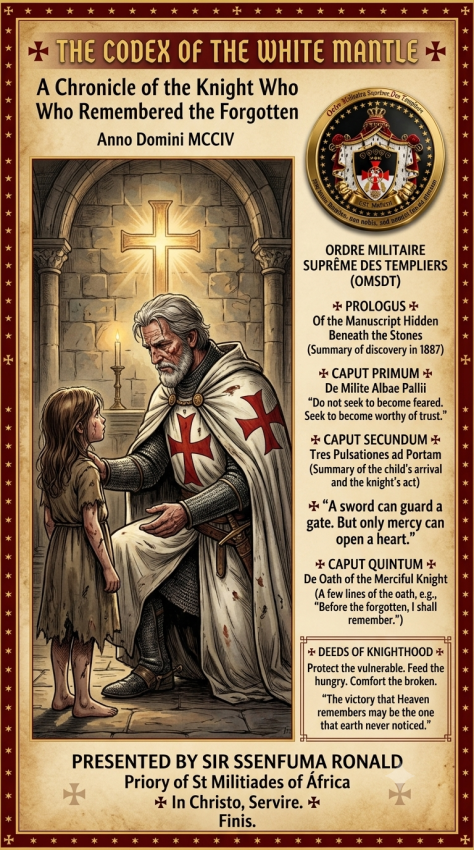
✠ THE CODEX OF THE WHITE MANTLE ✠
A Chronicle of the Knight Who Remembered the Forgotten
Anno Domini MCCIV
In Nomine Patris, et Filii, et Spiritus Sancti.
PROLOGUS
Of the Manuscript Hidden Beneath the Stones
In the winter of the year of Our Lord 1887, when the ruins of an ancient monastery were being cleared by the brethren, there was discovered beneath a fallen altar a chamber sealed with stones blackened by age.
Within that chamber stood an iron chest.
The chest was broken with rust.
... more✠ THE CODEX OF THE WHITE MANTLE ✠
A Chronicle of the Knight Who Remembered the Forgotten
Anno Domini MCCIV
In Nomine Patris, et Filii, et Spiritus Sancti.
PROLOGUS
Of the Manuscript Hidden Beneath the Stones
In the winter of the year of Our Lord 1887, when the ruins of an ancient monastery were being cleared by the brethren, there was discovered beneath a fallen altar a chamber sealed with stones blackened by age.
Within that chamber stood an iron chest.
The chest was broken with rust.
Within it lay fragments of parchment, bound together by leather so old that it crumbled beneath the fingers.
Upon the first leaf were painted a red cross and a single sentence:
“Read this not as a tale of war, but as a lesson in mercy.”
The name of the author had almost disappeared.
Only these words remained:
Brother Matthieu, servant of the Cross and keeper of the deeds of the brethren.
What follows is the portion that could still be read.
CAPUT PRIMUM
De Milite Albae Pallii
Of the Knight of the White Mantle
There lived in the Holy Land a knight called Sir Gabriel of Acre.
For thirty-seven years he had borne the mantle of the Order.
His shield had been broken in battle.
His sword had tasted the dust of many roads.
His armor carried scars like the lines of an ancient map.
He had seen cities burn.
He had seen men die.
He had seen kings rejoice over victories that left widows mourning behind the walls.
And because he had seen these things, he became a quiet man.
When the young knights spoke proudly of battle, Sir Gabriel remained silent.
When they asked him how a knight might become great, he answered:
“Do not seek to become feared. Seek to become worthy of trust.”
And when they asked him what was the strongest weapon of a knight, he answered:
“A heart that still has room for mercy.”
CAPUT SECUNDUM
Tres Pulsationes ad Portam
The Three Knocks at the Gate
It was during a bitter winter.
The moon was hidden.
The wind came down from the hills, carrying snow against the fortress walls.
The brethren had gathered in the chapel for prayer.
Candles burned before the Cross.
The priest began the evening prayers.
Then
Knock.
The brethren became still.
Again
Knock.
The captain looked toward the gate.
Then came the third.
Knock.
Three times.
The captain placed his hand upon his sword.
“No traveler would come in such a storm.”
Sir Gabriel rose from his knees.
“Open the gate.”
“My lord”
“Open it.”
The great doors groaned.
The storm rushed into the courtyard.
And there stood a child.
A little girl.
Barefoot.
Cold.
Alone.
Her clothing was torn.
In her hands she held a small piece of cloth.
The captain asked:
“Where are your parents?”
The child looked toward the ground.
“Gone.”
“Where shall you sleep?”
The child lifted her eyes.
“I do not know.”
Sir Gabriel said nothing.
He removed his white mantle.
He placed it around her shoulders.
Then he carried her through the gate.
CAPUT TERTIUM
Christus Sub Veste Pauperis
Christ Beneath the Garment of the Poor
The child was given bread.
She was given warm clothing.
She was given a place beside the fire.
But Sir Gabriel could not rest.
At midnight he entered the chapel alone.
He knelt before the Cross.
“Lord,” he whispered,
“why did You send her to us?”
The candle trembled.
The chapel remained silent.
Then the words of the Gospel returned to his heart:
“Whatever you did for one of the least of these... you did for Me.”
The old knight lowered his head.
And there, beneath the Cross, he understood.
Perhaps the child had not come asking:
“Will you help me?”
Perhaps Heaven had sent another question:
“Will you recognize Me?”
And the knight wept.
For the first time in many years, he wept not because of the battles he had fought
but because he understood the battle he had almost failed to see.
CAPUT QUARTUM
De Vera Militia
Of True Knighthood
At dawn, Sir Gabriel summoned the younger brethren.
He placed his sword upon the stone floor.
Then his shield.
Then his mantle.
He stood before them without the symbols of rank.
“My brothers,” he said,
“you have learned to fight.”
No one answered.
“You have learned to ride.”
Silence.
“You have learned to defend walls.”
He looked toward the little girl sleeping beside the fire.
“But have you learned to defend the defenseless?”
The young knights lowered their eyes.
Sir Gabriel continued:
«“A sword can guard a gate.
But only mercy can open a heart.”»
He pointed toward the child.
“Remember her.”
Then toward the hungry beyond the walls.
“Remember them.”
Then toward the sick and wounded.
“Remember them.”
Finally, he pointed toward the Cross.
“And remember Him.”
He lifted his sword.
“Let every sword defend the innocent.
Let every shield shelter the weak.
Let every hand be ready to serve.
Let every knight remember that his strength is not his own.”
Then he knelt.
And the young knights knelt with him.
CAPUT QUINTUM
De Oath of the Merciful Knight
The chronicler records that Sir Gabriel taught the brethren this oath:
«Before the Cross of Christ, I shall remember the forgotten.
Before the hungry, I shall not close my hand.
Before the orphan, I shall not close my door.
Before the wounded, I shall not turn away.
Before the helpless, I shall not remain silent.
I shall seek no glory where mercy is required.
I shall seek no praise where service is needed.
And if I possess strength, it shall be used to lift the weak.
If I possess bread, it shall be shared.
If I possess shelter, the stranger shall find refuge.
If I possess hope, I shall give it freely.
For I serve not the pride of men,
but Christ, the King of Mercy.
CAPUT SEXTUM
The Final Battle
Many years passed.
The child became a woman.
She devoted her life to caring for abandoned children.
Sir Gabriel grew old.
His sword remained beside him, but his hands had become too weak to lift it.
One evening she entered his chamber.
The old knight opened his eyes.
“Little one?”
She smiled.
“Yes.”
He took her hand.
“I wondered whether you would come.”
“I could never forget you.”
The knight shook his head.
“Then remember what happened that night.”
“You saved me.”
“No,” he whispered.
“I opened a gate.”
He pointed toward the Cross.
“Christ saved you.”
Tears filled her eyes.
“What shall I do with the life you helped preserve?”
The old knight smiled.
“Give it away.”
She did not understand.
“Give it away?”
“To the forgotten.”
His voice weakened.
“When you see a hungry child, feed them.”
“When you see an orphan, remember their name.”
“When you see someone broken, sit beside them.”
“When you find someone without hope, give them yours.”
His breathing became shallow.
Then came his final words:
«“Do not spend your life trying to become important.
Spend it becoming useful in the hands of God.”»
His eyes closed.
The chapel bell sounded.
Once.
Twice.
Three times.
And Sir Gabriel entered the silence from which no earthly knight returns.
CAPUT SEPTIMUM
The Stone Beneath the Cross
They buried him beneath the chapel.
No golden monument was raised.
No king came.
No trumpet sounded.
His sword was not placed upon his grave.
Only a small wooden cross.
And beneath it they carved:
HE REMEMBERED THE FORGOTTEN.
Brother Matthieu wrote beneath those words:
“I have seen knights win battles and kingdoms lose wars. Yet I tell you this: the victory that Heaven remembers may be the one that earth never noticed.”
ORATIO MILITIS
The Prayer of the Knight
O Domine Jesu Christe,
Lord Jesus Christ,
King of Heaven,
Guardian of the poor,
Defender of the helpless,
teach me to serve before I seek honor.
Give me courage to stand when others flee.
Give me compassion to remain when others turn away.
Give me wisdom to know when to speak.
Give me humility to know when to kneel.
When I see the hungry,
let me remember Your bread.
When I see the orphan,
let me remember Your love.
When I see the wounded,
let me remember Your wounds.
When I see the forgotten,
let me remember Your Cross.
Let my hands serve.
Let my heart forgive.
Let my life give hope.
And when my final hour comes,
let me not ask:
“How many knew my name?”
But:
“Whom did I help?”
Let me not ask:
“How much did I possess?”
But:
“How much did I give?”
Let me not ask:
“Was I honored by men?”
But:
“Was I faithful before You?”
And when I stand before Your throne,
if You should ask:
“Where are the little ones I placed upon your path?”
Let me answer:
«“They were not forgotten, Lord.
I remembered them.
I served them.
I loved them in Your name.”»
Amen.
ULTIMA PAGINA
The Last Writing of Brother Matthieu
The final page was badly damaged.
Only a few lines could be read.
Yet those lines were written in a stronger hand than the rest.
Perhaps they were written near the end of the brother's own life.
«“When the sword has rusted,
when the shield has fallen,
when the white mantle has become dust,
mercy shall remain.”
“When kings are forgotten,
when castles crumble,
when the names of warriors disappear,
the child who was given bread shall remember.”
“Therefore, whoever finds this manuscript,
remember this command:”
“Protect the vulnerable.”
“Feed the hungry.”
“Comfort the broken.”
“Remember the forgotten.”
“And when you have nothing left to give
give hope.”
For this is the mystery of the White Mantle:
the greatest knight is not the man who makes others fear him,
but the man beneath whose shadow the vulnerable are no longer afraid.
Finis.
✠ In Christo, Servire. ✠
In Christ, to serve.»
The Last Ride of Sir Edmund
The winter of 1203 was a cruel one.
For three days, snow had covered the narrow mountain roads surrounding the old Templar fortress of Saint Lazarus. The wind howled against the stone walls, and even the horses struggled to remain standing.
Among the knights was an aging Templar named Sir Edmund of Acre.
He had served for many years, but his body was beginning to fail him. An old wound in his leg made every step painful, and his once-black hair had turned silver.
... moreThe Last Ride of Sir Edmund
The winter of 1203 was a cruel one.
For three days, snow had covered the narrow mountain roads surrounding the old Templar fortress of Saint Lazarus. The wind howled against the stone walls, and even the horses struggled to remain standing.
Among the knights was an aging Templar named Sir Edmund of Acre.
He had served for many years, but his body was beginning to fail him. An old wound in his leg made every step painful, and his once-black hair had turned silver.
The younger knights often urged him to retire.
One evening, the fortress received word that a group of pilgrims had become stranded in the mountains.
There were twelve of them.
Among them were women, two elderly men, and several children.
The storm was growing worse.
The commander gathered the knights.
“No one travels tonight,” he declared. “We will search for them at first light.”
Sir Edmund looked toward the dark mountains.
Then he quietly stood.
“I know those roads.”
The commander shook his head.
“Your leg will not carry you through this storm.”
Sir Edmund smiled.
“Then I shall take a horse.”
A young knight named Thomas stepped forward.
“I will go with you.”
Sir Edmund placed a hand on his shoulder.
“No. Stay here.”
“Why?”
The old knight looked at him.
“Because one day you will have to make a difficult journey of your own.”
Before Thomas could answer, Sir Edmund mounted his horse and disappeared into the snow.
Hours passed.
Then, shortly before dawn, the fortress guards heard horses approaching.
The gate opened.
Sir Edmund returned.
Behind him came the twelve missing pilgrims.
The children were wrapped in his cloak.
His horse was exhausted.
So was he.
The knights rushed toward him.
But Sir Edmund did not dismount.
He simply pointed toward the stable.
“Take care of them first.”
The pilgrims were carried inside.
Warm food was prepared.
The children were placed beside the fire.
Only then did the knights notice the blood on Sir Edmund's boot.
His old wound had opened during the journey.
He had lost so much blood that he could barely remain seated.
Thomas knelt beside him.
“Why didn't you tell us?”
Sir Edmund looked at the young knight and smiled.
“Because you would have tried to stop me.”
That morning, Sir Edmund was carried into the chapel.
He knew he would not leave it again.
Thomas sat beside him until evening.
As the candles burned low, Sir Edmund reached beneath his cloak and removed a small wooden cross.
He placed it in Thomas's hand.
“I want you to keep this.”
Thomas shook his head.
“No, Brother. You should keep it.”
Sir Edmund smiled.
“I have carried it long enough.”
The young knight lowered his head.
“Will you be afraid?”
Sir Edmund looked toward the chapel window.
Beyond it, the snow had finally stopped.
“I was afraid many times,” he said.
Thomas looked surprised.
“You were?”
The old knight nodded.
“Every brave man is afraid sometimes.”
He paused.
“The difference is what you do next.”
Those were his final words.
Sir Edmund died before sunrise.
The following spring, the young knights found something unusual.
Near the mountain road stood a small wooden shelter.
Someone had built it for travelers caught in the storms.
Above its doorway was a simple wooden cross.
No name.
No title.
No record of who had built it.
Thomas knew.
He had the old knight's cross around his neck.
Years later, when Thomas himself had become an old knight, he would often stop beside that shelter whenever he passed through the mountains.
Travelers would sometimes ask him:
“Who built this place?”
Thomas would look at the cross above the door.
Then he would answer:
“A knight who understood that some journeys are worth making, even when you know you may never return.”
And he would continue down the road.
The wooden shelter remained there for generations.
Long after the fortress walls had fallen.
Long after the names of kings had disappeared from memory.
The little cross still stood above the door.
And beneath it were the only words Thomas had ever allowed to be written:
“For those who are still on the road.”
🛡️ THE KNIGHT WHO KNEELED BEFORE THE WOUNDED
A Story of Humility, Mercy, Faith, and the True Meaning of Knighthood
There once lived a Knight who had everything that the world could admire.
He possessed a beautiful sword.
He wore polished armour.
He carried the insignia of his Order with pride.
Kings knew his name.
Brothers respected his rank.
People praised his courage.
Wherever he travelled, people saw a powerful Knight.
But there was one thing he had forgotten.
He had forgotten why ... more🛡️ THE KNIGHT WHO KNEELED BEFORE THE WOUNDED
A Story of Humility, Mercy, Faith, and the True Meaning of Knighthood
There once lived a Knight who had everything that the world could admire.
He possessed a beautiful sword.
He wore polished armour.
He carried the insignia of his Order with pride.
Kings knew his name.
Brothers respected his rank.
People praised his courage.
Wherever he travelled, people saw a powerful Knight.
But there was one thing he had forgotten.
He had forgotten why he became a Knight.
One evening, after a long journey, the Knight was riding toward a great city where he was expected to receive another honour.
Along the road, he noticed an old man sitting beside a tree.
The man's clothes were torn.
His face was tired.
His hands trembled.
The Knight slowed his horse but continued riding.
Then he heard the old man whisper:
“Sir Knight… please.”
The Knight stopped.
He turned around.
“What do you need?”
The old man pointed toward the road.
“My son has fallen sick. I have been trying to carry him home, but I no longer have the strength.”
The Knight looked at his armour.
He looked at his sword.
Then he looked at the old man.
For a moment, he thought about the ceremony waiting for him.
He was already late.
He could hear the voice of his companions in his mind:
“The Knight must not keep the Order waiting.”
But then he remembered the words he had spoken when he first became a Knight:
“I will serve.”
He climbed down from his horse.
He removed his gloves.
And he lifted the sick young man onto his back.
The road was long.
The mud was deep.
The Knight's armour became covered in dirt.
His expensive cloak became torn.
His boots became soaked.
But he continued walking.
The old father walked beside him with tears in his eyes.
After several hours, they reached their home.
The Knight gently placed the young man on his bed.
The family had almost nothing.
No medicine.
Very little food.
No money.
The Knight quietly opened his purse.
He gave them what he had.
The old man began to cry.
“Sir, I cannot repay you.”
The Knight placed his hand on the man's shoulder.
“You don't have to.”
Then he turned and walked away.
When the Knight finally reached the city, the ceremony was almost finished.
His brothers looked at him.
His armour was dirty.
His cloak was torn.
His boots were covered with mud.
One of them laughed.
“Where have you been?”
The Knight simply replied:
“Serving.”
The hall became quiet.
The Grand Master looked at him.
“Serving whom?”
The Knight answered:
“Someone who needed me more than I needed your ceremony.”
Nobody spoke.
Then the Grand Master slowly approached him.
He looked at the Knight's dirty armour.
He looked at the torn cloak.
And then he smiled.
“Brother,” he said,
“Tonight, you have worn the finest armour a Knight can ever wear.”
The Knight bowed his head.
“What armour is that?”
The Grand Master answered:
“Humility.”
Years passed.
The Knight grew old.
His sword eventually became too heavy to carry.
His armour was placed in a chest.
His victories became stories told by others.
One evening, he sat beside his fireplace.
He looked at his medals.
He looked at his old sword.
He looked at his insignia.
And he asked himself:
“What will remain after I am gone?”
Then there was a knock at the door.
An elderly man entered.
Behind him was a young woman holding a little boy's hand.
The old man looked at the Knight.
“Do you remember me?”
The Knight shook his head.
The old man smiled.
“Many years ago, you carried my sick son home.”
The Knight became silent.
The old man pointed toward the young woman.
“This is his daughter.”
Then he pointed toward the little boy.
“And this is his grandson.”
The Knight's eyes filled with tears.
The old man continued:
“My son survived.
He became a teacher.
His daughter became a nurse.
And his grandson…”
He looked down at the child.
“…dreams of becoming a doctor.”
The old man smiled.
“You helped save one life.
But you never knew how many lives that one life would touch.”
The Knight lowered his head.
A tear fell onto his old hands.
He finally understood something profound:
We rarely see the full harvest of the good we plant.
⚔️ THE TRUE MEANING OF KNIGHTHOOD
Brother Knights,
perhaps this is the question every Knight must eventually answer:
What does your knighthood mean when nobody is watching?
It is easy to wear the insignia.
It is easy to speak about honour.
It is easy to attend ceremonies.
It is easy to receive recognition.
But true knighthood begins when there is nothing to gain.
When you help someone who cannot repay you.
When you defend someone who cannot defend themselves.
When you feed someone who cannot thank you.
When you encourage someone who has lost hope.
When you kneel beside someone whom the world has forgotten.
That is where the true spirit of the Knight is revealed.
There are children who need someone to believe in them.
There are families struggling behind closed doors.
There are elderly people living in loneliness.
There are sick people waiting for compassion.
There are communities waiting for someone to bring hope.
And somewhere, perhaps today, there is someone praying:
“Lord, send somebody.”
Maybe the answer is you.
Maybe the answer is us.
🕊️ BROTHER KNIGHTS, LET OUR FAITH BECOME ACTION
Let us not merely speak about charity.
Let us practice it.
Let us not merely speak about brotherhood.
Let us demonstrate it.
Let us not merely speak about courage.
Let us stand when others are afraid.
Let us not merely speak about faith.
Let our faith produce good works.
Let our wealth become a blessing.
Let our influence become responsibility.
Let our titles become opportunities to serve.
Let our brotherhood become a shelter for those in need.
And when we encounter someone who has fallen—
let us kneel.
Not because we are weak,
but because we are strong enough to lift them.
🛡️ THE KNIGHT'S FINAL TEST
One day, our swords will become silent.
Our armour will grow old.
Our photographs will fade.
Our titles will eventually belong to history.
But the lives we touched will continue.
The child we educated may educate another.
The person we encouraged may encourage someone else.
The family we helped may one day help another family.
The hope we planted may become a light for an entire community.
Therefore, Brothers, let us never underestimate a single act of goodness.
One meal can restore strength.
One book can open a future.
One kind word can prevent despair.
One helping hand can restore dignity.
One Knight who chooses to stop can change a life.
And when our final day comes, may we not be remembered merely because we wore a magnificent uniform.
May we not be remembered merely because we carried a distinguished title.
May we not be remembered merely because our names appeared on certificates.
May we be remembered because someone lived better because we lived.
May a child say:
“That Knight believed in me.”
May a widow say:
“That Knight stood beside me.”
May a sick person say:
“That Knight did not abandon me.”
May a poor family say:
“That Knight remembered us.”
And may our brothers say:
“He served faithfully.”
✝️ THE KNIGHT'S PRAYER
Lord,
Give me courage without pride.
Give me strength without cruelty.
Give me wisdom without arrogance.
Give me wealth with generosity.
Give me authority with humility.
Give me faith that produces action.
When I see suffering, do not allow me to walk away.
When I see hunger, make me willing to share.
When I see a fallen brother, give me the strength to lift him.
When I see a forgotten child, remind me that every life has value.
And when my own journey is finished,
let the good I have done continue speaking after I am silent.
Not for my glory.
Not for my name.
Not for my honour.
NON NOBIS, DOMINE.
Not unto us, O Lord, not unto us, but unto Thy Name give the glory.
⚔️ BROTHER KNIGHT, GO FORTH
Carry your sword as a symbol of courage.
Carry your shield as a symbol of protection.
Carry your cross as a reminder of sacrifice.
But carry love in your heart.
Go where others are afraid to go.
Stand where others choose to remain silent.
Give where others refuse to share.
Lift those who have fallen.
Protect those who are vulnerable.
Encourage those who have lost hope.
And wherever your path takes you,
leave behind something better than you found.
Because the greatest Knight is not the one who stands above others.
The greatest Knight is the one who kneels beside them.
And the greatest victory is not the battle you win.
It is the life you save.
NON NOBIS, DOMINE.
May our swords defend.
May our shields protect.
May our hands serve.
May our hearts love.
And may our lives become a light for those walking in darkness.
THE LITTLE GIRL WHO REMEMBERED THE KNIGHT
A Story of Sacrifice, Mercy, and the Legacy of a Servant
The Knight had spent his entire life searching for greatness.
He had ridden through distant lands.
He had stood beneath banners.
He had worn magnificent armour.
He had been praised for his courage and honoured for his service.
People knew his name.
People respected his title.
People admired his achievements.
But there was one thing he secretly feared:
That when his life was over, none of... moreTHE LITTLE GIRL WHO REMEMBERED THE KNIGHT
A Story of Sacrifice, Mercy, and the Legacy of a Servant
The Knight had spent his entire life searching for greatness.
He had ridden through distant lands.
He had stood beneath banners.
He had worn magnificent armour.
He had been praised for his courage and honoured for his service.
People knew his name.
People respected his title.
People admired his achievements.
But there was one thing he secretly feared:
That when his life was over, none of it would truly matter.
One winter morning, the Knight travelled through a poor village.
The rain had fallen all night.
The roads were muddy.
Children stood barefoot beside small houses whose roofs were leaking.
The Knight saw hunger in their faces.
He saw mothers trying to comfort crying children.
He saw an old man sitting alone beside a broken doorway.
But the Knight continued riding.
He had important matters to attend to.
He had meetings.
He had responsibilities.
He had a ceremony waiting for him in another town.
Then, as he passed the village square, he heard a small voice.
“Sir Knight…”
He stopped.
Behind him stood a little girl.
She was perhaps seven years old.
Her clothes were old and wet.
She had no shoes.
In her hands she held a small piece of bread.
She looked at the Knight's horse and then at his shining armour.
“Sir,” she asked, “are you a good Knight?”
The Knight smiled.
“I try to be.”
The girl looked at him seriously.
“Then can you help my mother?”
The Knight's smile disappeared.
“What is wrong with your mother?”
“She is sick.”
“And where is she?”
The girl pointed toward a small house.
The Knight followed her.
Inside, he found the girl's mother lying on a thin mattress.
There was almost no food.
There was no medicine.
There was no money.
The Knight looked around.
For the first time that day, he forgot about his meeting.
He removed his cloak.
He placed it over the woman.
Then he took money from his purse and sent someone to find medicine and food.
The little girl watched silently.
Before leaving, the Knight gave the family enough money to survive for several weeks.
The little girl looked up at him.
“Why did you help us?”
The Knight answered:
“Because you asked.”
She smiled.
“Will you come back?”
The Knight hesitated.
“Yes,” he said.
But he did not know whether he would.
Years passed.
The Knight grew older.
His hair became grey.
His body became weaker.
His victories became memories.
His medals gathered dust.
His beautiful armour remained locked inside a chest.
Eventually, the Knight became seriously ill.
He knew his journey was coming to an end.
One evening, he sat alone beside his window.
He looked at the medals on his wall.
He looked at his sword.
He looked at his old armour.
And suddenly, he wondered:
“What will remain when I am gone?”
His victories?
No.
His titles?
No.
His wealth?
No.
Then he remembered the little girl.
He remembered her standing barefoot in the rain.
He remembered her asking:
“Are you a good Knight?”
The old Knight closed his eyes.
A tear rolled down his cheek.
He whispered:
“I hope I was.”
The next morning, there was a knock at the door.
His servant opened it.
An elegantly dressed woman stood outside.
She was carrying flowers.
She asked:
“May I see the Knight?”
The servant hesitated.
“He is very weak.”
The woman replied:
“I have travelled a very long way.”
She entered the room.
The old Knight looked at her.
He did not recognize her.
“Who are you?”
The woman smiled through tears.
“Do you remember a little girl from a village many years ago?”
The Knight stared at her.
Then his eyes widened.
“You…”
She nodded.
“I was the little girl.”
The Knight began to cry.
The woman knelt beside his bed.
“My mother survived because of you.”
She paused.
“You gave us medicine.
You gave us food.
You gave us hope.”
The Knight whispered:
“I only did what any Knight should do.”
The woman shook her head.
“No, Sir.”
She took his hand.
“You did what many people could have done—but chose not to.”
She began to cry.
“My mother taught me something before she died.”
“What?”
“She said, ‘Never forget the Knight who stopped.’”
The old Knight looked at her.
“What do you mean?”
She answered:
“Many people passed our house that day.
Some saw us.
Some felt sorry for us.
Some promised to help.
But you…”
She squeezed his hand.
“You stopped.”
The room became silent.
Then she continued:
“I became a teacher.
I built a small school in my village.
Every year, I tell my students about the Knight who taught me that kindness is stronger than poverty.”
The Knight could no longer hold back his tears.
He looked toward his sword.
Then toward his medals.
Then toward the woman.
And he finally understood.
His greatest achievement had never been the battles he won.
It had never been the honours he received.
It had never been the people who applauded him.
His greatest achievement was simply this:
He had stopped.
He had seen one suffering person.
And he had refused to walk away.
That night, the old Knight died peacefully.
The woman remained beside him.
When the sun rose, she looked at his sword hanging on the wall.
She whispered:
“Rest now, Sir Knight.”
Then she added:
“Your work continues.”
THE LESSON OF THE KNIGHT
Brothers, perhaps every generation of Knights is given the same question that little girl asked:
“Are you a good Knight?”
Not:
“How many titles do you possess?”
Not:
“How many medals have you received?”
Not:
“How many people know your name?”
Not:
“How powerful are you?”
But:
“When you saw someone suffering, did you stop?”
When you saw a hungry child, did you stop?
When you saw a struggling family, did you stop?
When you saw an orphan without hope, did you stop?
When you saw someone grieving, did you stop?
When you saw injustice, did you stop?
When you saw someone fall, did you extend your hand?
Because the world does not need more people who simply wear the appearance of greatness.
The world needs people who are willing to do the work of goodness.
There are children who will never remember the name of the person who helped them.
But they will remember the feeling of being cared for.
There are families who may never repay your generosity.
But their children may grow up because you gave.
There are communities that may never give you a medal.
But they may survive because someone decided to serve.
And perhaps that is the mystery of true knighthood:
You may never know how far one act of kindness travels.
The bread you give today may feed a child tomorrow.
The school you help build may educate a generation.
The hospital you support may save a life.
The word of encouragement you speak may prevent someone from giving up.
The hand you extend today may create a leader for tomorrow.
Your smallest act of mercy may become someone's greatest reason to hope.
BROTHER KNIGHTS, LET US STOP
Let us stop when others walk past.
Let us stop when suffering calls.
Let us stop when a child needs protection.
Let us stop when someone needs encouragement.
Let us stop when humanity needs compassion.
Let us stop asking:
“What do I gain?”
And begin asking:
“What can I give?”
Because one day, our armour will be silent.
Our swords will be placed away.
Our titles will belong to history.
Our photographs will fade.
Our voices will no longer be heard.
But somewhere in this world, there may be a person who says:
“There was a Knight who stopped for me.”
And perhaps that sentence will be our greatest monument.
THE FINAL CHARGE
Therefore, Brothers, carry your title with humility.
Carry your sword as a symbol of courage.
Carry your shield as a symbol of protection.
But above all:
Carry compassion in your heart.
Let your wealth become generosity.
Let your influence become service.
Let your position become responsibility.
Let your brotherhood become unity.
Let your faith become action.
Let your courage become protection for the vulnerable.
And let your life become a living testimony that knighthood is not about being above others it is about standing beside those who need you.
If you can feed one hungry child
feed them.
If you can educate one child
educate them.
If you can comfort one grieving family
comfort them.
If you can save one life
save it.
If you can restore one person's hope—
do not hesitate.
Because you may never see the full fruit of your kindness.
You may never know whose life you changed.
You may never receive a medal.
You may never hear applause.
But Heaven sees.
And history remembers.
The greatest Knight is not the one who conquered the most.
He is the one who lifted the most.
Not the one who was served by many, but the one who served many.
Not the one who demanded to be remembered, but the one whose goodness made others unforgettable.
So when the final day comes and someone asks:
“What did you do with your knighthood?”
May our answer be simple:
“I stopped.”
“I saw suffering.”
“I saw a child.”
“I saw a brother.”
“I saw a human being in need.”
“And I did not walk away.”
NON NOBIS, DOMINE.
Not unto us, O Lord, not unto us, but unto Thy Name give the glory.
May our swords represent courage.
May our shields represent protection.
May our hands represent service.
May our hearts represent compassion.
And may our lives leave behind a light that continues burning long after we are gone.